
Dividend
Definition
A dividend is a payment made by a corporation to its shareholderstypically in the form of cash or additional sharesas a distribution of profits.
Dividends represent a return on equity investment and are a critical component of shareholder value. They are declared by the board of directors and paid from retained earnings.
Origins
Dividends date back to the 1600snotably with the Dutch East India Companywhich paid shareholders out of trade profits. Over timedividends became a key feature of equity investingespecially for income-focused investors and pension funds.
Usage
Industry Applications:
-
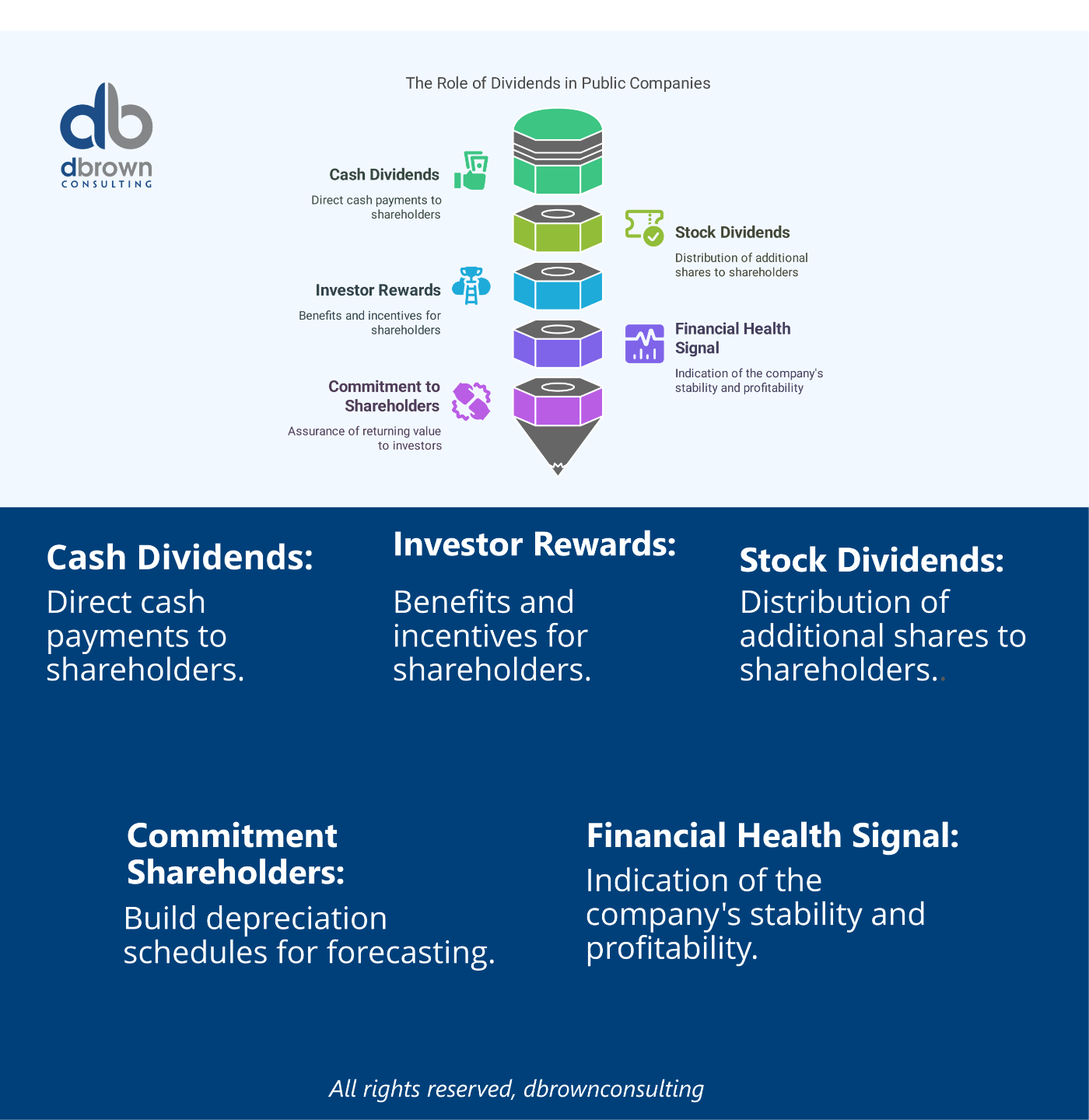
Public Companies – Distribute profits as cash or stock dividends.
-
REITs & MLPs – Required to distribute most earnings to retain tax advantages.
-
Dividend Investing – Portfolio strategy centered on dividend-paying stocks.
-
Corporate Finance – Dividend policy reflects capital allocation strategy.
-
Valuation – Used in dividend discount models (DDM).
How Dividend Works
Dividend Lifecycle:
-
Declaration Date – Board announces dividend and record/payable dates.
-
Ex-Dividend Date – Cut-off for eligibility; stock trades without dividend.
-
Record Date – Shareholders on record will receive the dividend.
-
Payment Date – Dividend is distributed to shareholders.
Sources of Dividend:
-
Net income (after tax)
-
Retained earnings
-
In some jurisdictionsrestricted by legal or loan covenants
Key Takeaway
-
Dividends are optionalnot guaranteed (unless preferred shares).
-
Reflect financial healthmanagement confidenceand maturity of a business.
-
High dividends may indicate lower growth opportunities.
-
Tax treatment varies (e.g.qualified vs. ordinary dividends in U.S.).
Types of Dividend
Type |
Description |
|---|---|
| Cash Dividend | Most common; paid directly in cash. |
| Stock Dividend | Issued in the form of additional shares. |
| Special Dividend | One-timenon-recurring payout (e.g.post-asset sale). |
| Interim Dividend | Paid before year-end financials are finalized. |
| Preferred Dividend | Fixed-rate dividends on preferred sharestypically cumulative. |
| Liquidating Dividend | Return of capital; company winds down or returns excess assets. |
Context in Financial Modeling
Dividends play a critical role in:
-
Three-statement models: Impact retained earnings and financing cash flows.
-
Dividend Discount Models (DDM): Used to estimate intrinsic value of equity.
-
LBO Models: Modeled in dividend recaps to extract equity value.
-
Scenario planning: Model dividend sustainability under stress tests.
Dividend Policy Types:
-
Residual: Paid after investment and debt needs.
-
Stable: Maintain consistent payout regardless of earnings.
-
Target Payout Ratio: Fixed % of earnings (e.g.40% payout ratio).
Nuances & Complexities
-
Payout Ratio: High ratios may be unsustainable if earnings fall.
-
Dividend Irregularity: Inconsistent dividends can signal instability.
-
Debt vs. Dividend: Capital-intensive firms may prefer reinvestment.
-
Buybacks vs. Dividends: Some firms favor repurchases due to tax efficiency or flexibility.
Mathematical Formulas
1. Dividend per Share (DPS):
2. Dividend Yield:
3. Payout Ratio:
4. Retention Ratio:
5. Dividend Growth (g) (for DDM):
Master Financial Modeling with the FMA
Change your career today by earning a Globally Recognized Accreditation
Develop real-world financial modeling skillsgain industry-recognized expertisestand out and start earning more by gaining the Advanced Financial Modeler (AFM) designation from the Financial Modeling Institute.
Our expert-led online cohort based program covers everything you need to become a world class financial modeling pro and advance your career in finance.
Related Terms
-
Earnings per Share (EPS)
-
Retained Earnings
-
Share Buyback
-
Dividend Yield
-
Dividend Discount Model (DDM)
-
Payout Ratio
-
Capital Allocation
Real-World Applications
1. Blue-Chip Dividend Stocks
Coca-Cola and Johnson & Johnson are examples of dividend aristocratsconsistently increasing dividends for over 25 years.
2. Dividend Discount Valuation
An investor models a stock using the Gordon Growth Model:
Where is expected dividend is cost of equityand is dividend growth rate.
3. Dividend Recap in PE
A private equity firm performs a dividend recapitalizationtaking out debt to pay themselves a one-time cash dividend.
4. REIT Distribution Requirements
A REIT is required by law to distribute ≥90% of taxable incomeoften resulting in high dividend yields.
References & Sources
Unlock the Language of Finance!
Elevate your financial acumen with DBrown Consulting’s exclusive newsletter. We break down complex finance terms into clearactionable insights—empowering you to make smarter decisions in today’s markets.
Subscribe Today & Make Financial Jargon Simple!
We won't send spam. Unsubscribe at any time.