



Organs
Your organs are what make you who you areand they run every body process you need to live. They aren’t just parts inside youlike your liver or lungs. They also include parts on the outside of your bodylike your eyes and mouth. But whether or not you can see them or realize they’re hard at workthey’re a key part of every day of your life.
Advertisement
Cleveland Clinic is a non-profit academic medical center. Advertising on our site helps support our mission. We do not endorse non-Cleveland Clinic products or services. Policy
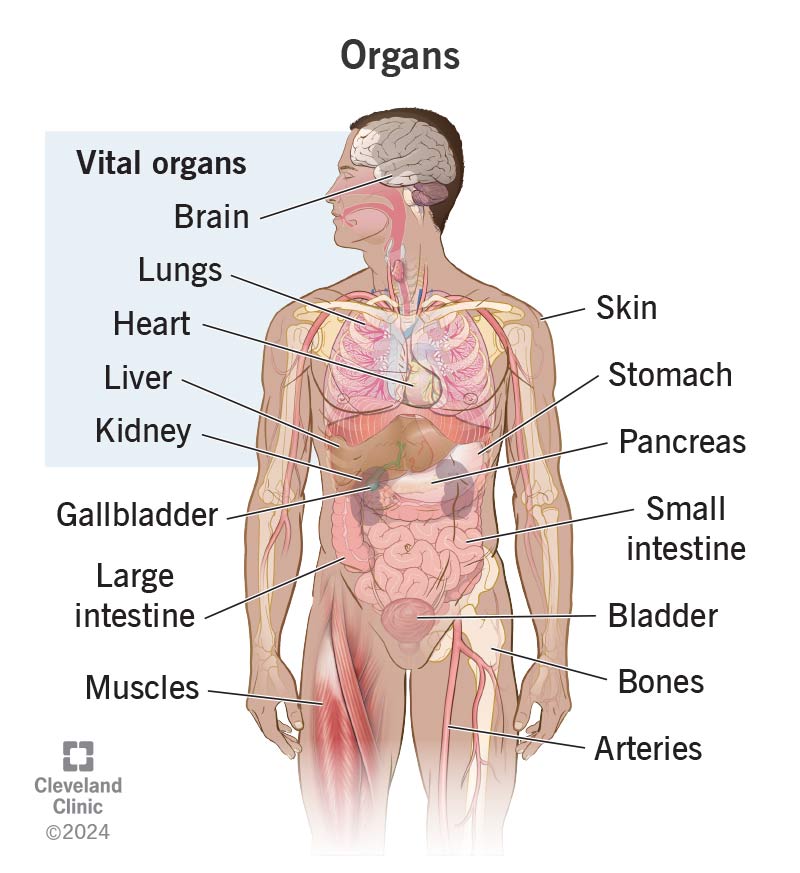
Image content: This image is available to view online.
View image online (https://my.clevelandclinic.org/-/scassets/images/org/health/articles/organs.jpg)
What are organs?
Organs are specialized structures in your body that handle specific jobs. Some of the best-known organs are your heartbrain or liver. But many other structures count as organstoo. That includes some you might not think oflike your skin.
Advertisement
Cleveland Clinic is a non-profit academic medical center. Advertising on our site helps support our mission. We do not endorse non-Cleveland Clinic products or services. Policy
Each of your cells is like an individual worker doing a specific job. Tissues are groups of related cells teamed up in the same place. Organs consist of many tissues that work together cooperatively to accomplish a bigger job.
Organs are part of bigger systems that handle interconnected jobs. And some organs can be part of more than one system. Some examples of organ systems and the organs that are part of them include:
- Cardiovascular. Your heart is this system’s main organ. It also includes major vessels like your arteries and veinsand smaller vessels like your capillaries.
- Digestive. This includes your stomach and intestines (small and large). But it also includes structures like your esophagus and openings like your mouth and anus (butthole).
- Endocrine. This includes your pancreas and glands like your thyroid and adrenalsto name a few.
- Immune. This includes your spleen and bone marrow (which makes all kinds of blood cellsincluding immune-related ones).
- Musculoskeletal. This includes your muscles and all the bones of your skeleton. It also includes certain types of connective tissue like ligaments and tendons.
- Nervous. Your brain and spinal cord are the main organsplus all the nerves in your body. Your sensory organs like your eyesears and nose are also part of this system.
- Reproductive. This includes the ovariesvaginauteruspenisprostate and testicles.
- Respiratory. This includes your openings like your nose and mouthplus internal organs like your lungs.
- Urinary. This includes internal organs like your kidneys and bladderplus external genitals like the penis.
Advertisement
Organs can be single structures like your heart. But they can also be a group of the same type of structure. For exampleyour bones are technically an organbut so is the bone marrow inside most of your bones.
How many organs are there?
You might get a different answer depending on who you ask. Before 2016the number of organs was widely recognized as 78. But researchers continue to expand modern medicine’s understanding of how the body works. That’s whyif you ask experts today how many organs you havethe answer can range from 78 to 80.
In particulartwo discoveries explained in research papers from 2016 and 2018 now have experts split on the true number. The two organs that are gaining acceptance but still have some controversy behind them are:
- The mesentery. This layer wraps around and contributes to how your immune and lymphatic systems influence your digestive tract. The 2020 printing of Gray’s Anatomy42nd edition recognized the mesentery as a true organ. That brought the total number of organs to 79.
- The interstitium. This is a network of fluid-filled spaces between your cells. There’s strong evidence it spans your entire bodyincluding in and around major organs.
There’s still a lot of ongoing research into how these organs work and what they do. And advances in technology and medical science may lead to further discoveries.
What are vital organs?
Vital organs are organs that you need to survive. Your body can’t function without them. Some key examples of vital organs include your:
- Brain
- Heart
- Kidney
- Lungs
- Liver
What organs are on one side of the body?
You have several organs that are centered inside your bodywhile others are clearly to one side.
Some examples of centered organs in your body include your:
- Brain
- Bladder
- Heart (it’s mainly centered but slightly leftexcept with rare conditions like dextrocardia)
Some examples of left-side organs include your:
- Pancreas
- Stomach
- Spleen
Examples of right-side organs include your:
- Appendix
- Gallbladder
- Liver
And you have several paired organswith one on each side of your body. They include your:
- Lungs
- Kidneys
- Eyes
- Ears
- Reproductive organsincluding external ones like testicles and internal ones like ovaries
What organs can I survive without?
You can survive without several organs. They include your:
- Appendix
- Gallbladder
- Ovaries and/or uterus
- Spleen
- Testicles
- Large sections of your bowels or the entire colon
You can also survive with just one of several paired organslike your lungs or kidneys.
While you can’t survive without your heart or at least one kidneythere are artificial versions that can do their jobs. Artificial hearts can be long-term replacements for damaged or diseased hearts. And dialysis can be a long-term substitute (but not a permanent replacement) for your kidneys.
Advertisement
What are accessory organs?
Accessory organs are organs that contribute to a body systembut they might not necessarily be a clear part of it. One example is your gallbladderwhich contributes to your digestive system. Breasts are another example. They can contribute to your reproductive system during breastfeeding.
But being an accessory organ doesn’t mean that organ isn’t important. Your liver is an accessory organ to your digestive systembut you also can’t live without it.
What is the largest organ in the body?
The largest body organ you have is your skin. It makes up about 15% of your total body weight. But for just your internal organsthe largest is your liver.
A note from Cleveland Clinic
Organs aren’t just something you have inside you. There are plenty of parts on the outside of your bodylike your eyes and other facial featuresthat are organstoo. It can be easy to take them for grantedespecially when everything’s working as it should. But if you’re sick and you have an organ issueit can be hard to think about much else. If you have questions about taking care of your organ healthtalk to a healthcare provider. They can offer guidance on how to best take care of your organs and your health overall.
Advertisement



Better health starts here
Sign up for our Health Essentials emails for expert guidance on nutritionfitnesssleepskin care and more.
Experts You Can Trust
Learn more about the Health Library and our editorial process.
References
Cleveland Clinic’s health articles are based on evidence-backed information and review by medical professionals to ensure accuracyreliability and up-to-date clinical standards.
References
Cleveland Clinic’s health articles are based on evidence-backed information and review by medical professionals to ensure accuracyreliability and up-to-date clinical standards.
- Benias PCWells RGSackey-Aboagye Bet al. Structure and Distribution of an Unrecognized Interstitium in Human Tissues (https://www.ncbi.nlm.nih.gov/pmc/articles/PMC5869738/) [published correction appears in Sci Rep. 2018 May 10;8(1):7610. doi: 10.1038/s41598-018-25732-x]. Sci Rep. 2018 Mar 27;8(1):4947. Accessed 12/5/2024.
- Betts JGDeSaix PJohnson JEet al. Anatomy and Physiology. 2nd ed. OpenstaxRice University; 2022.
- Coffey JCO’Leary DP. The mesentery: structurefunctionand role in disease (https://pubmed.ncbi.nlm.nih.gov/28404096/). Lancet Gastroenterol Hepatol. 2016 Nov;1(3):238-247. Accessed 12/5/2024.
- Drake RLVogl AWMitchell AWM. Abdomen. In: Drake RLVogl AWMitchell AWMeds. Gray’s Anatomy for Students. 5th ed. Elsevier Inc. 2024:247-409.
- Standring S (ed). Gray’s Anatomy. 42nd ed. Elsevier Limited; 2020.
Care at Cleveland Clinic
Cleveland Clinic’s primary care providers offer lifelong medical care. From sinus infections and high blood pressure to preventive screeningwe’re here for you.
