
Standard Banner Sizes in InchesFeet & Pixels [+FixThePhoto Tips]
When you purchase through affiliate links on our sitewe may earn a commission. Here’s how it works.
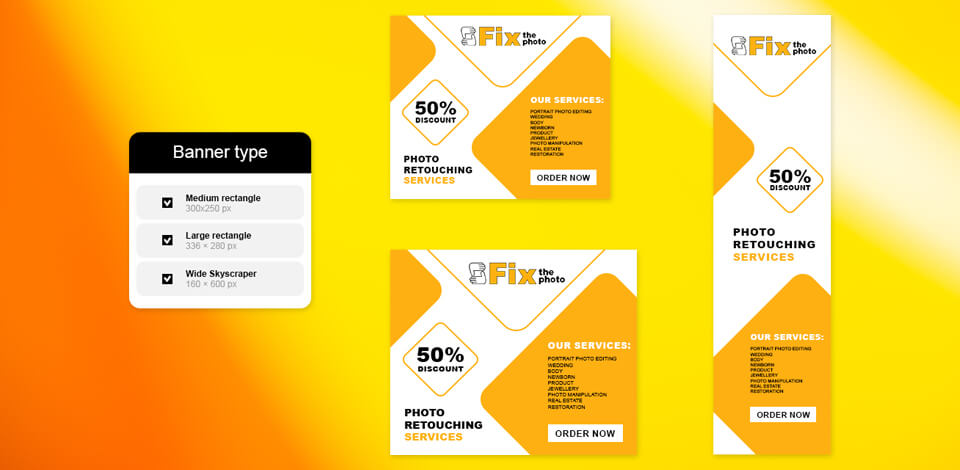
Picking the right banner size is a lot more important a decision than it may seemregardless of whether you’re working on a store promosocial media ador a showcase event. The banner primarily serves to announce something while combining imagerytypographyand branding to instantly convey the necessary information.
From small 2′ by 4′ prints to bigger 728×90 web leaderboardsthere’s a purpose behind all standard banner sizesand picking the optimal one for your specific project can be the difference between a successful and failed marketing campaign or event.

As a long-term member of the FixThePhoto teamI’ve always enjoyed working on banners. I design them for all kinds of projectsfrom web-based workshops on image retouching to seasonal discounts on our photography services.
During the early stages of my careerI found out that even captivating designs can go to waste if you don't choose the right dimensions. An incorrect size can crop the textdistort imagesor lead to the banner being ignored entirely since it wasn’t a good fit for the platform.
I’ve prepared a guide to go over all the most popular banner sizes for print and webcovering their purpose and providing recommendations on how to choose the dimensionsdesign your bannerand export it properly. It will help you produce professional results in any scenario.
Why Stick to Standard Banner Sizes
When helping newly hired designers and marketers at FixThePhotoI begin by stating one rule: “Never design a banner before you decide its size.” It may feel obvious to youbut a lot of people completely ignore this recommendation.
By choosing one of the standard banner sizesyou establish a predictable framework while resting assured that your design is compatible with popular online platformsdevicesand print mediums.

For web advertising, the Interactive Advertising Bureau (IAB) defines the average banner dimensions as 300×250 or 728×90 pixelswhich are resolutions used for everything from Google Ads to Facebook.
These “standard” dimensions ensure the ads are shown properly and aren’t rejected or resized by the platform you’re uploading them to. The easiest way to set the proper sizes is to use free pre-made banner templates.

For printstandardization is tied to practicality. Printers and signage enterprises have adjusted their materialsvinyl rollsand pricing to standard photo sizes and popular banner sizes in inches (3′×6′4′×8′and 6′×12′). If you choose one of those optionsyou’ll cut costsprevent trimming problemsand guarantee your design scales perfectly from screen to fabric.
The main benefits of using normal banner sizes include:
If you try to experimentyou risk running into issues like:
That’s why you should determine the size before you even start working on a banner. That’s the first brick you have to lay down.
Why Size Impacts Design and Performance
Allow me to provide an example of a photography workshop banner that I made recently. FixThePhoto created a digital campaign and a bunch of printed vinyl banners to advertise a free “Portrait Retouching 101” class.
For the webwe prepared 300×250 rectangle ads that offered a 2.3× better click-through rate than the non-standard ads we tested. The printed 3′×6′ vinyl banner was presented outside the studio. It offered the optimal balance – big enough to be read from a distanceyet small enough to be transported to future events.
This is important because:
- A normal banner size ensures the text-to-image ratio is optimized for readability.
- A preserved aspect ratio prevents unwanted cropping on digital screens.
- Big banners (like 6′×12′) catch the attention of driverswhile smaller banners (2′×4′) are better suited for enclosed spaces like reception areas or booths.
Picking fitting banner dimensions is essential for properly conveying your message without requiring the viewer to squint or scroll.
Standard Banner Size Chart
Before you get to workI recommend visualizing a banner-size chart in inchesfeetcentimetersand pixelsso that you’re covering both print and digital usage cases. I tend to have such a chart at hand when working on marketing assets for our photo workshops or social media campaigns.
| Web banner type | Pixels | Inches | Use case/placement |
|---|---|---|---|
|
Leaderboard
|
728 × 90 px
|
10.1″ × 1.25″
|
Header or footer on sitesforums
|
|
Large Rectangle
|
336 × 280 px
|
4.7″ × 3.9″
|
In-article or post-end display ads
|
|
Medium Rectangle
|
300 × 250 px
|
4.2″ × 3.5″
|
Sidebarblogphone-friendly layout
|
|
Wide Skyscraper
|
160 × 600 px
|
2.2″ × 8.3″
|
Vertical sidebars or scrollable layouts
|
|
Mobile
|
300 × 50 px
|
4.2″ × 0.7″
|
Mobile appslower/top screen bar
|
|
YouTube
|
2560 × 1440 px
|
35.5″ × 20″
|
YouTube headersocial media branding
|
I tend to show this chart to all new employeesparticularly if they’ve been assigned to create multi-format campaigns that repurpose designs across different print and digital mediums.
| Printed | Inches | Feet | Cm | Visible up to | Use case |
|---|---|---|---|---|---|
|
Small vinyl
|
24″ × 60″
|
2′ × 5′
|
60 × 150
|
15 ft
|
Indoor signswindow displays
|
|
Medium vinyl
|
36″ × 72″
|
3′ × 6′
|
90 × 180
|
25 ft
|
Storefrontsboothssales ads
|
|
Large vinyl
|
48″ × 96″
|
4′ × 8′
|
120 × 240
|
40 ft
|
Exteriorshigh-traffic zones
|
|
Horizontal
|
72″ × 48″
|
6′ × 4′
|
180 × 120
|
40 ft
|
Fencesstageshorizontal displays
|
|
Vertical
|
96″ × 24″
|
8′ × 2′
|
240 × 60
|
35 ft
|
Entrancesindoor columns
|
|
Retractable
|
33″ × 81″
|
2.75′ × 6.75′
|
84 × 206
|
20 ft
|
Trade showslobbiesevents
|
|
Pole
|
24″ × 48″
|
2′ × 4′
|
60 × 120
|
25 ft
|
Street polescampusesfairs
|
|
Outdoor billboard
|
72″ × 144″
|
6′ × 12′
|
180 × 360
|
100 ft
|
Billboardshighwaysstadiums
|
Understanding Each Common Banner Size
Now let’s examine typical banner sizes more closely. These are the dimensions I tend to use most often when creating marketing assets for FixThePhoto.
Web Banner Sizes

Leaderboard – 728×90 px. This is an internet staple. You’ll usually find it at the top of a webpagegrabbing your attention before you even begin scrolling. I tend to employ it for promoting free retouching workshops on the FixThePhoto website.
- Best for: site headersforumsnews sites
- Why it’s great: widepanoramic layout that can contain both an image and an enticing call-to-action (CTA).
- Pro tip: Place the text in the center and keep it brief. Don’t stack lines vertically so that you don’t waste horizontal space. Remember to account for kerning in typography for improved readability.

Large rectangle – 336×280 px. If you’re going for a striking and balanced ad blockyou should consider this banner size. It’s perfect for product highlights or showcasing before/after image editing examples.
- Best for: end-of-article placements or inside blog posts.
- Why I like it: allows featuring both eye-catching imagery and text.
- Bonus idea: Consider including a “Try Now” or “Watch Demo” button to improve performance in retargeting campaigns.

Medium rectangle – 300×250 px. I think it’s the most efficient option for web content. It looks great on phoneslaptopsand PCs alike and delivers great results on all ad networks.
- Best for: sidebarsmobile adsarticle embedding
- FixThePhoto example: I pick this size for “Download Free Photography Marketing Templates” campaignsas it allows me to combine captivating visuals with straight-to-the-point CTAs.
- Banner design tip: Reduce the banner’s size to 150 KB or less (Google’s ad size limit). Preserve a 1:1 text-to-image ratio.

Mobile banner – 300×50 px. This small banner size is perfect for phones. While it doesn’t give you a lot of room to work withyou can utilize it to increase brand awareness as long as your design is clean and balanced.
- Best for: smartphone app adspop-upsand at the bottom of phone screens
- Design tip: Employ striking color contrast and no more than 2-3 words to prevent a clattered look

Wide skyscraper – 160×600 px. This tallvertical format is ideal for sidebars or content-rich sites. I employ it when making promotional banners for FixThePhoto’s seasonal discounts.
- Best for: blog sidebarssocial media widgetsand making a YouTube banner in Photoshop
- Creative tip: Employ the vertical layout to “stack” crucial information: brand → service → CTA. Such a structure will guide the viewer's eye downward.
Print Banner Sizes
In contrast to digital adsprint banners exist in the physical worldso they need a different approach. When working on such a projectI save the files in PDF or TIFF formatCMYK color modeand a resolution of 300DPI or more. Let’s examine the most popular banner sizes for print (and chosen for vinyl and fabric banners).

2′×5′ (24×60 in / 60×150 cm). Small and easy to transportwhich is perfect for indoor events like photography meetups or small booths.
- Best for: pop-up eventsbehind countersand window displays.
- Why it’s effective: despite being rather smallit remains readable from about 10-15ft.
- Tip: Place the logo at the top third and an eye-catching CTA at the bottom.

3′×6′ (36×72 in / 90×180 cm). My go-to choice. This standard banner size is suitable for the majority of possible scenariosfrom store promotions to outdoor markets.
- FixThePhoto use: we have 3×6 banners on the exterior of our studios when doing “50% Off Wedding Retouching” sales.
- Printing advice: choose sturdy vinyl with reinforced edges that you can get from a local photo printing serviceas this material will endure both rainfall and sunlight.

4′×8′ (48×96 in / 120×240 cm). A large-scale banner that instantly catches the passerby’s eye – ideal for big events and product releases.
- Best for: exterior wallsfencesor stages.
- Design note: stick to relatively minimalistic imagery; don’t use small fonts since readability begins at about 40-50ft.

6′×4′ (72×48 in / 180×120 cm). In many ways comparable to 4×8 but with flipped orientation. Perfect for wide storefronts or fences.
- When I choose it: for wide booths at photography expositionsand you can conveniently hang it behind a desk.
- Pro tip: If the banner is meant for long-term useask for grommets on all edges to simplify the installation process.

8′×2′ (96×24 in / 240×60 cm). This long vertical layout looks elegant and is a great choice for indoor spaces.
- Perfect for: hallwaysbuilding entrancestall columns.
- Design tip: limit text to a single brief message since vertical reading is more challengingespecially from a bigger distance.
Retractable & Pole Banners

Retractable banner – 33×81 in. If you ever see a FixThePhoto booth at an eventyou'll notice that we use such a banner a lot. It's compacttransportableand requires minimal setup.
Why I love it: It can be rolled upstoredand reused.
Best for: trade showspop-up workshopsand photography contests.
Design tip: Keep the logo at eye level and leave around 10-12” of visual “breathing room” at the bottom (the retractable base can somewhat obscure it).
Pole banner – 24×48 in. Perfect for the outdoors. We chose it to promote local workshops on lamp posts.
Best for: streetscampusesor festival branding.
Material tip: use double-sided printing and pole pocketswhich help improve wind resistance.
Choosing Between Digital and Print
A quick comparison I often show clients:
| Use case | Best banner type | Common size | Recommended format |
|---|---|---|---|
|
Online promotions
|
Digital
|
300×250 px
|
PNGJPG (RGB72 DPI)
|
|
Outdoor sales
|
Vinyl
|
3′×6′
|
PDFTIFF (CMYK300 DPI)
|
|
Trade shows
|
Retractable
|
33×81 in
|
PDFPSD
|
|
Street advertising
|
Pole
|
24×48 in
|
PDFJPG
|
|
Website header
|
Leaderboard
|
728×90 px
|
PNGHTML5
|
|
Indoor event
|
Small vinyl
|
2′×5′
|
PDFPNG
|
When Custom Banner Sizes Make Sense

A standard banner size isn’t always the answer. Some expo booths have weird layoutsor a client can ask for a panoramic banner that covers the entire wall. This is when custom sizes come into play.
When planning FixThePhoto eventswe sometimes have no choice but to experiment. For instancewe made a 10′×3′ panoramic vinyl banner for our studio façade. While the proportions aren’t standardit’s still eye-catching and effective at drawing in clients.
Howeveryou should still follow this rule: Always start from a standard ratio.
Whether you scale up or downstick to aspect ratios like 3:14:3or 16:9. This ensures the design looks balanced and doesn’t distort logos or faces.
Pros of custom banner sizes:
Cons:
When working on custom-sized bannersdo all the measurements twice and check the resolution. A 6′×10′ banner printed at 150 DPI will demand an image over 10,000 px wide.
How to Choose the Right Banner Dimensions

If a client of ours helps us to help them choose the optimal banner size for printing or digital useI mention these 5 steps:
1. State your purpose. Ask yourself: “What am I advertising?”
- Brand awareness: large-scale banners with eye-catching images to build your brand identity.
- Short-term sales: medium-sized banners with easy-to-read text.
- Directional signage: tall or narrow banners with arrows or event information.
2. Measure the display area. Take a tape measureorif you’re making a digital bannerstudy the platform requirements. Oversized designs look unprofessional if they don’t fit the space they’re in.
3. Consider the viewing distance. The basic rule of thumb when calculating the banner size in inches: 1 inch of letter height = 10 feet of readability. So if the viewer is 50 feet awaythe letters need to be at least 5” tall.
4. Choose the printing material wisely. Outdoor vinyl banners need to be weatherproof and UV-resistant. For indoor bannersfabric or matte finishes on photo paper look more appealing under soft lighting.
5. Budget wisely. Bigger banners and custom finishes (like double-sided printing) can be significantly more expensive. Meanwhileprinting multiple standard 3′×6′ banners is generally more cost-efficient than a single large custom design.
Professional Banner Design Tips

Having designed hundreds of banners over the yearsfrom social media promos to huge 4x8 vinyl showcases – I’ve established a smooth workflow that helps me produce high-qualityprint-ready results. Regardless of which banner design size you choosethe same rules are still relevant.
Simplicity is key – one messageone image. All efficient banners have a clear focus. A banner isn’t a brochure. It needs to convey all its information within 3 seconds.
Golden rule: One image. One headline. One clear call to action (CTA).
If the banner requires the audience to pause and thinkyou lost the battle before it even started. I tend to choose cleanhigh-contrast backgrounds and a single dominating visual. For instancea retouched picture that clearly conveys the subject.
If you’ve chosen a smaller banner size like 2′×5′the minimalism becomes even more important.

Keep the branding consistent across all materials. A cohesive helps raise brand awareness. Whenever someone stumbles upon your bannerit needs to share the visual language with your siteflyersand social media pages. At FixThePhotowe adhere to a consistent by using:
- Identical font pairings across all assets.
- A consistent color palette that fits the logo and tone (light graywhitetealand orange accents).
- Repetitive design elementsincluding icons and shapesare used to make printed and digital materials feel similar.
If you’re creating visuals for an entire marketing campaigncheck the standard flyer size or business card size layouts to ensure the typography and alignment are done right. Such consistency can help make even a smaller banner look professional.
Prioritize readability and hierarchy. Banners are typically seen for only a second or two – be it from a distanceon a screenor when walking past them. This is why it’s essential to remember about visual hierarchy:
- Headline (biggestboldest)
- Supporting subline (smallermedium weight)
- CTA (high contrastseparated by space or color)
For outdoor banner sizesstick to the “1 inch per 10 feet” rule. For instanceif the banner will be usually seen from 40ft awayensure the headline text is 4” or taller. Some typography tips:
- Pick sans-serif fonts like HelveticaMontserrator Open Sans – they offer great readability from a distance.
- Don’t use scripts and thin typefaces.
- Avoid using more than two font families per design.
Leverage composition and balance. A balanced layout sets the great banners apart from the mediocre ones. All components need to guide the viewer’s eye – from the image → headline → CTA. Consider these tips:
- Follow the rule of thirds – arrange the focal image off-center to add dynamic tension.
- Employ grids to align text blocks and logos.
- Include margins around edges (around 1 inch for print banners) to ensure the design doesn’t get trimmed.
For vertical banners (like retractable banners or pole banners)I prefer to “stack” elements vertically while sorting them by relevancy. For wide ones (like leaderboards or 4′×8′ vinyls)I stick to a horizontal “flow” from left to right.

Pick the optional colors and mood. Colors aren’t just window dressing – they affect the viewer’s emotional response and conversion rates. I employ color psychology with purpose:
| Color | Effect | Best for |
|---|---|---|
|
Red
|
Urgencyexcitement
|
Clearance salesCTAs
|
|
BlueBlue
|
Trustprofessionalism
|
Corporate or service banners
|
|
Green
|
Eco-friendly or wellness promos
|
Eco-friendly or wellness promos
|
|
Yellow
|
Energyoptimism
|
Announcementsspecial offersAnnouncementsspecial offers
|
|
Black & white
|
Eleganceminimalism
|
Premium photography services
|
Remember to check how your chosen color palette looks both in natural and artificial lighting – vinyl banners tend to seem darker when printed.
Stick to high-resolution photos and vector graphics. Don’t upscale low-res images. At FixThePhotowe only use vector logos (SVGEPS) and retouched photos to prevent pixelation.
- For print bannersstick to 300 DPI images in CMYK color mode.
- For digital designssave images in 72 DPI in RGB.
If your banner contains photosconsider having them retouched by a professional service firstsince enhanced lighting and colors can significantly increase their quality.

Testexportand proof. Before you sign off on any design:
- Print a small-scale proof to verify color accuracy.
- Test colors and readability from the intended viewing distance.
- Export multiple versions for print and web (different color profiles).
My last rule. “If you can’t read everything in 3 secondsit’s a bad design.” I have this post-it above my monitor. Whether you pick a standard banner size for a sales announcement or custom dimensions for a wall-sized event backdropyour design needs to convey the intended message quickly and clearly.
How I Design Banners at FixThePhoto

I prefer to employ Adobe Express to enjoy a smooth and efficient workflow. Even with the Adobe Express free versionI can conveniently resize designs for several platforms while also brainstorming various ideas.
If you want to have even more control over your digital and vinyl bannersAdobe Photoshop is still the best option on the market. You can fine-tune the tiniest detailemploy maskingand create smart objects to scale different elements.
Adobe’s software also includes (for vector files) and Lightroom (for tone-matching visuals)streamlining the task of producing cohesive imagery.
Vinyl banner sizes aren’t the only thing I have in mind when I start to work on a new project. For examplefor the “Free Portrait Retouching Webinar” promoI created both digital and printed bannerspreserving the same color palette and fonts for visual coherency. My workflow usually follows these steps:
Step 1. Choose the right canvas. In Photoshopselect File → New → Document and pick the desired banner dimensions (for print300 DPI CMYK; for web72 DPI RGB).
Step 2. Leverage grids and safe zones. Ensure the text and logos are at least 1″ away from edges to ensure they aren’t trimmed out.
Step 3. Only use high-quality images. Stick to the highest quality image formats availableRAW or TIFF if possible. Don’t add low-res JPGs.
Step 4. Stylize the message. Employ contrasting tones and never go above two fonts. If you’re struggling with typographyAdobe Express offers premade “font combinations” that can serve as a fantastic foundation.
Step 5. Export with intent:
- Web banners: save as PNG or JPG≤ 150 KB.
- Print banners: save in the best image format for printingeither PDF or TIFFin 300 DPI.
FREE Bonus Tools

If you need to design promotional or event bannersyou’ll appreciate this collection. FixThePhoto provides a hand-picked selection of free Photoshop banner templateswhich you can start using and personalizing straight away.
Whether you’re deciding the optimal banner size in feet for a grand event openingor working on a little promotional banner to post on Facebook or Instagramthese templates will help get you startedproviding professionally-designed layouts and color paletteswhile ensuring there’s enough free space to prevent edge trimming. You can use them with all modern Photoshop versions to create both print and digital designs.
FAQ
- • What is the most popular banner size?
3′×6′ is widely regarded as the most widely used format. It’s big enough for visibility yet compact enough to be used indoors. For digital use300x250px is the go-to choice for many marketers.
- • What’s the typical banner size in inches?
Popular options are 24×60 in36×72 inand 48×96 in for printand 728×90 px for web use.
- • What’s the optimal banner size for print?
A 3′×6′ vinyl banner is ideal for most business promotions. It balances visibilityportabilityand cost.
- • What is the standard outdoor banner size in cm and inches?
Outdoor 4′×8′ (10x20cm) and 6′×12′ (15x30cm) banners are often used for roadside or large-venue promotions since they preserve legibility even at a distance of 40 feet or more.
- • What banner size can be considered small?
Dimensions like 2′×4′ and 24’×48’ are a good choice for booth tablesindoor wallsand reception areas.
- • What are the standard banner dimensions for trade shows?
Retractable banners around 33×81” are the industry norm. They offer great portability and height while also being convenient to transport.
- • Can I pick non-standard banner sizes?
Yesbut you should still stick to standard aspect ratios (3:14:3etc.) to ensure the design doesn’t get stretched out or distorted.
<>
.tm-bottom-author > .uk-grid {
align-items: center;
}
@media (max-width: 639px) {
/*.tm-bottom-author > .uk-grid {*/
/* align-items: flex-start;*/
/*}*/
}
.tm-bottom-author-avatar {
max-width: 150px;
}
.tm-bottom-author-name {
font-size: 26px;
font-weight: bold;
margin-top: 0;
margin-bottom: 0;
}
.tm-bottom-author-position {
font-size: 20px;
font-weight: normal;
margin: 15px 0 0 0;
}
.tm-bottom-author {
max-width: 910px;
}
@media (max-width: 639px) {
.tm-bottom-author svg {
width: 20px;
height: 20px;
}
.tm-bottom-author-name {
font-size: 20px;
line-height: 1;
margin-top: -3px;
display: table-caption;
/*max-width: 200px;*/
}
.tm-bottom-author-position {
font-size: 16px;
margin-top: 10px;
line-height: 1.1;
}
.tm-bottom-author-position + div {
margin-top: 10px !important;
}
.tm-bottom-author-avatar {
max-width: 120px;
}
}




YOU MAY ALSO LIKE:


![Best Design Magazines Worth Subscribing [Print & Digital]](/blog/images/gallery/news_main__preview_27834.jpg)


![25 Best Pregnancy Announcement Ideas [Tips from an Expert]](/blog/images/gallery/news_main__preview_25177.png)

RECENT POSTS:




Languages:
© Copyright 2026 Fixthephoto.com | All Rights Reserved.

