
InspectAPedia®FREE Encyclopedia of Building & Environmental ConstructionDiagnosisMaintenance & Repair |
Question? Just ask us!< type="text/css"> @import url(https://cse.google.com/cse/api/branding.css); InspectAPedia
|
 Floor Drain Odor Problems
Cause & Cure
of odors traced to floor drains
- POST a QUESTION or COMMENT about how to track down and cure basement floor drain odors & smells
Floor drain odors & smell troubleshooting:
This article explains how to track down and cure a sewer gas odors that appear to be due to basement or crawl space floor drain or drain trap problems.
We describe the likely sources of sewer gas or septic smells that seem to come from a floor drainand we explain how to complete the diagnosis & cure of these odor problems.
This article lists solutions for stopping sewer gas odors & sewage backups through un-trapped or un-sealed floor drains and lists sources of trap sealstrap guardsand check valves used for that purpose.
The sketch of a plumbing trap primer system shown at page top was provided courtesy of Carson Dunlop Associatesa Toronto home inspectioneducation & report writing tool company [ carsondunlop.com ].
InspectAPedia tolerates no conflicts of interest. We have no relationship with advertisersproductsor services discussed at this website.
- Daniel FriedmanPublisher/Editor/Author - See WHO ARE WE?
Floor Drain or Drain Trap Odors: Leak & Repair Diagnosis Suggestions
 Our photo shows a floor drain that is often found to be an odor source.
Draining air conditioning or heat pump condensate in this manner can solve two problems at once.
Avoiding a dry plumbing trap and disposing of A/C or heat pump condensate.
Reader Question: having trouble finding source of a septic odor
I am having a heck of a time finding where the septic odor is coming from. We have a 3 story house on a septic tank and drain field.
The odor seems to be strongest and most often present in a mechanical room in the basement.
The only plumbing in the room is a floor drain [photo at left from reader]. No other drains are under the concrete slab. I know because I built the house.
I suspect that drainbut the water level in the trap seems to be full and I even sent a metal feeler down to make sure the bend in the trap was below the water level.
The concrete floor does have settling cracks. Is it possible that the plastic drain pipe could be slightly cracked or loose glue joint down stream from the trapcaused by the settling concrete?
Would plugging the 4 inch drain just outside the house and filling the drain with water up to the top of the floor drain give enough pressure to any leaks thereby lowering the level of the water in the drain?
Assuming all the other drains downstairs are slightly higher than the specific drain in question.
 Only other thing I can think ofis the roof vent plugging from leaves etc. going down a 2 in. vent stack. If that pluggedwould that allow gas to come into the building?
[Photo at left (from reader) shows a portion of the drain-waste-vent DWV piping in this building.]
This house is 30 years old and this problem is about a year old.
This question is a tough especially with all the floors being finished with tile or carpet.
I was an electrical contractor so I do have tools and abilities for any of your suggestionsi.e.: shove a metal fish tape down the drains and then trace the tape to verify the drain path under the concrete slab.
Any help is appreciated. Thanks- D.M.
Reply: Floor drain and trap odor diagnosis suggestions
Rooftop plumbing vent as odor cause
It would be uncommon for leaves to block a roof vent unless the vent projection above the rooftop were very short and the vent was covered with leaves (or snow).
But we have indeed seen roof vent pipes blocked by frost if there is a shower or laundry or other source of hot water that sends a lot of steam up the vent in very cold weatheresp. if the vent is small in diameter - say under 2";
We have also found roof vents blocked by wasp nestsand once even a frog.
If you can safely examine the vent from rooftop without falling off due to snow or other slippery conditionsit's worth taking a look.
Other plumbing vent failures that send odors into buildings include a vent or drain line that is disconnected inside the building due to an unglued joint or broken drain line; These should show up as an odor or when you perform a pressure test of the vent line.
Of course if your floor drain piping is actually used to drain a plumbing fixture (such as a washing machine) and the drained fixture is more than 5' from any plumbing ventthen depending on what waste flows through that drain lineit could on occasion siphon water out of the trap and allow odors into the building.
It is also possible to siphon water out of a remote but un-vented trap as waste passes down the joined drain linebut that problem would have been present from the time of original construction whereas your problem has just recently appeared. And you've confirmed that there is water in the basement floor trap so that's not our first suspicion.
Drain line under the floor as odor source
Indeed we have had cases of under-floor drain lines that were leakysending sewage odors into the building; that problem is more common when the under-floor drain is carrying sewage.
See CAST IRON DRAIN LEAKODORREPAIR for an example.
If you have easy access to this same drain line from outdoors and can temporarily block the line at that point it would be a good diagnostic tool since you are sure that there is no other plumbing connected to this drain.
If you block the line from outdoors (and at a point before it joints any other sewer piping) then if that's the odor sourcethe odor ought to stop.
If that step confirms that the line is the odor sourceand presuming the building is new enough that your piping is plastic not cast iron under the floorI'm guessing that the bad news is the line would have to be abandoned (sealed off outside) or dug up and replaced.
Before doing so it may be worth asking a plumber who has a drain line inspection camera to send that through the line to see what's going onon the chance that you can find and dig up just a short section of line that is damaged or disconnected.
Floor drain trap as odor source

It is interesting that you found the floor trap filled with water. Often a floor drain whose only function is to catch on-floor flooding in a basement is so seldom used that its floor trap dries out and sewer gases pass backwards into the building.
We solve that problem either by pouring some mineral oil into the drain trap or installing a floor trap that includes a check valve designed specifically to prevent gases from passing backwards up the drain line and into the building.
When a building is more than a year old and the floor trap is always filled with waterand if we think that the drain line is never usedwhere is that water coming from?
Is that a clue that there is water under the building leaking into the trap (i.e. an open or broken drain)?
Other Possible Sources of Basement Sewer Odors
 If blocking the drain line off outside the home does not stop the odor there are some of the other possibilities:
- Sewage previously backed up into and leaked out of the line into a settled cavity under the floor,
continuing to create an odor source - Wewer line cleanout cover has been left off
(our photo above) or is leaking - Odor is not from that drain line but perhaps from another building drain
leaking into the basement ceiling or walls. - Other "sewer-like" odors that might be found in a mechanical room
could be from some different source - a dead animala chemical spillor if there are odors in the building water supplysulphur in the water or if in hot waterbacteria or a bad anode in the water heater tank.
Additional floor drain or trap odor problem diagnostic questions:
- Condition of buried drain lines:
Are we sure we know the piping layout under the floorthe materials usedand quality of connections? - Signs of building movement that could have cracked a drain line:
Do floor slab cracks or other signs of settlement mean that slab movement may have damaged the under-floor drain piping?
See CONCRETE SLAB CRACK EVALUATION. - What drains in to this floor drain?
Anything? or is it just for water spillage? - What connects to the floor drain?
In other wordsare we sure that the drain line connected to absolutely no other building plumbing?
Follow-up from reader about smelly basement floor drain
Whole drain is not 4 in…4 inch is a main drain with taps off of it under the slab. The floor drain in question is a 2 inch line and trap. All abs piping.
Drain in question is just for spillage as is the other one in a different room. The reason water is in the trap is because I diligently keep it full. Have thought of putting antifreezelike a travel trailer usesinstead of mineral oil. But not until this is settled.
Check all roof vents this morning with a 1/4in metal fish tape. No restriction and a visual with flash light showed no problem. Alsothe gas odor coming out seemed consistent at all four roof vents.
Since last writingI did plug the 4 in drain just outside the home and then filled all the pipe under the slab until the water level was even with the top of the floor drains. I left it for 14 hours and the water level never changed. ThereforeI feel there is not a big leak under the slab. I suppose a real small leak might take more time to be apparent. An air test would be more accurate but would complicate plugging the pipe completely.
After plugging the 4 inch lineI aired out the house and no odor returned. This makes sense because all the lines leading to the septic tank were plugged with water. Alsothis morning I had the tank emptied. It probably could have gone another three yearsbut because of the problemI had it cleaned anyway.
After careful review of when this intermittent problem occursIt seems like the odor follows the draining of one particular bath tub. The tub was used for three consecutive daysand each of those days we had the odor. Is there any type of flushing action that can cause the odor getting through.
Rememberthis is a problem that occurs when it is cold outnot neccesarily freezingand the problem started a year or so ago and we have been here for 20 years..I can’t even think of a place where a nail could have been put through a pipe. No one works on this house but me..
Included four pics; 1. The outside four inch clean out used to plug entire house drain 2. The suspect floor drain [see at top of this Q&A] 3. Misc. piping to suspect tub/lav/ toilet area on first flooras seen from basement [see at top of this Q&A] 4. Outside ventsall were clear…
What can you tell me about a smoke test? I am looking into plugging all pipes and putting and doing an air pressure test. This would take the talk out of a leak but would not tell me where it is..ugh…
Tracing an Indoor Sewer Gas Odor to an Un-Trapped Basement Floor Drain
Keep in mind that some basement floor drains don't include a trap and may need one to stop smells from that source. Dry traps at un-used sinks in a basement or other building area are also common sources of sewer smells in buildings. Because sewer gas contains explosive methaneit can be dangerous.
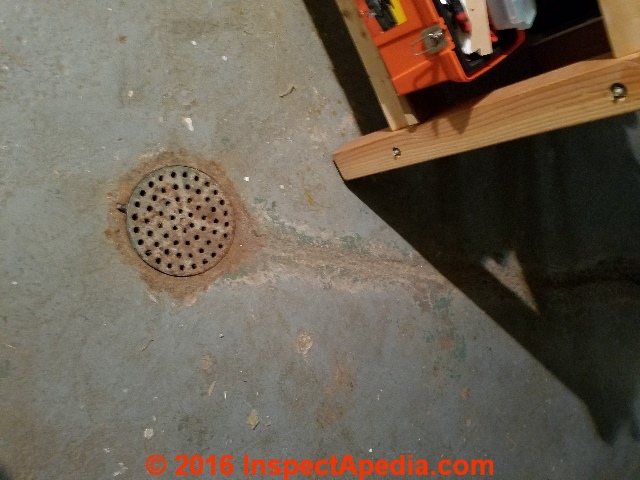
The floor drain shown above included a clue that prior owners/occupants of this Poughkeepsie NY home had experienced basement water entry: someone had cut a small trench in the concrete basement floor to direct water from a point of water entry at the house rear wall over to a floor drain.
Watch out: it is common for basement floor drains to be installed without any trap whatsoever. Basement floor drains or in-slab floor drains in buildings without a basement or crawl space are intended to handle either spills onto the floor or un-wanted building water entry in order to reduce indoor flood damage.
But depending on the routing and destination of an in-floor drainground waterfloodwatersor even sewage from a septic or sewer backup may flow up the drain and into the building in some conditions.
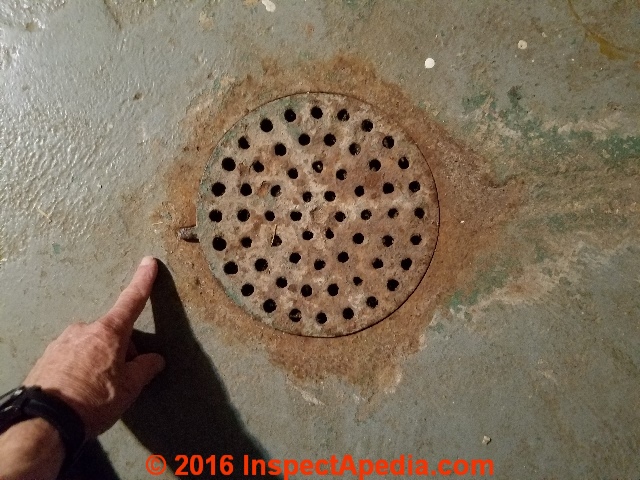
When investigating sewer gas odors in buildings we have often traced these smells to an un-trapped floor drain. We also describe this problem at SEWAGE PUMP ODORS. Below: we have removed the floor drain cover to take a look into the drain piping.
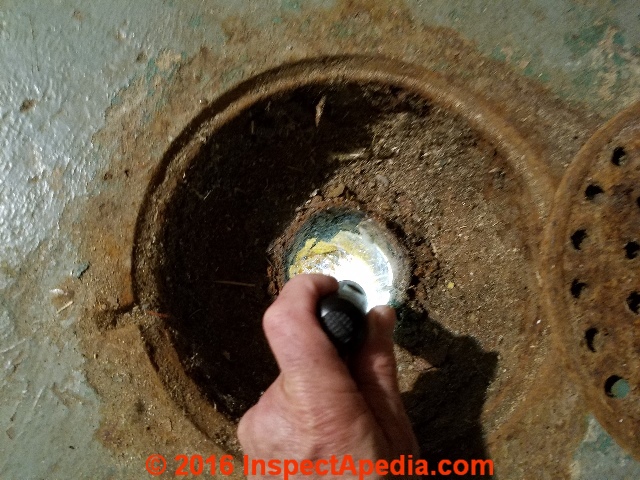
As you can see belowthe floor drain does not appear to have a trap installed.
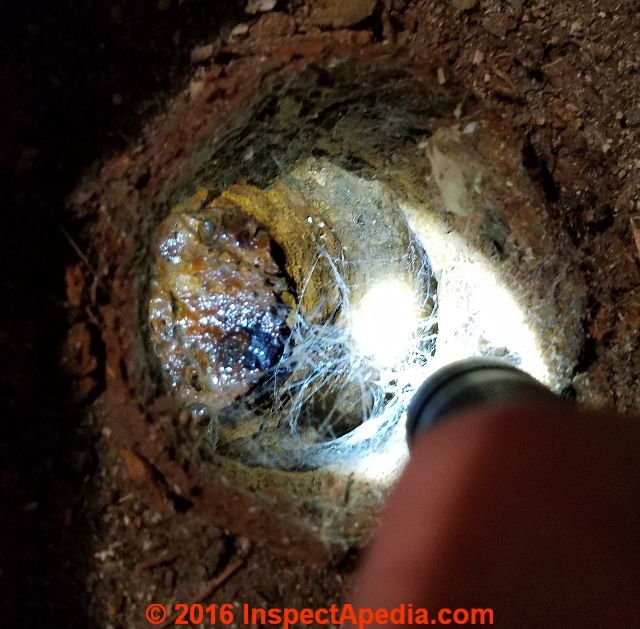
While some floor drains are routed indepndently to an acceptable drainage destination such as daylight above-ground or to a storm drainothers are connected to the building DWV system and ultimately to a septic or sewer piping system.
Piping the floor drain to a septic system is not a smart idea as it risks overloading and damaging the septic system. Piping floor drains to a community sewer or storm drain system is prohibited in some jurisdictions.
Solutions for Sewer Gases or Sewage BackupsDry Plumbing Traps & Un-Trapped Floor Drains
Reader Comment: bad odor coming from my kitchen drain
10 January 2015 Thank you
I want to thank you for having an easy to use site. I had been dealing with a "smell" in my home that came and went. I have a cat that occasionally brings in a mouse,bird or larger critter that will pass on while in the house. This was the type of smell.
Death. No simpler way to put it. I looked under all the furnituremoved the washer and dryerno little dead critter to be found. Turned my attention to the septic system. I was just getting ready to call a septic company and thought I would "Google" my issue and see what I could find. After reading really vague and useless page after page I came upon your website.
There was the answerplain as could be. Dry drain. We have a shower that hadn't been used in a few monthsalong with some very windy conditioned dried the plumbing. I turned on the shower and let it run for a few minutes along with pouring a few gallons of water down a floor drain in my laundry room.
Smell left almost instantly! I wish I had found your website first. Your information is so very much appreciatedand the time you took to put it out there for us to use.
Most sincere appreciation. -
Alison 1/10/2015
12 October 2019 Brandy said
I have a bad odor coming from my kitchen drain and under my front room floor. I just rented this apartment. The maintenance person put acid in the k.sink. This didn't work. Also m.person put plastic over some pipe under the house
Reply: Four Solutions for Repairing a Smelly Floor Drain
Alison
Thank you in return for such a generous note. We work hard on our information and are thus thrilled when a reader finds it useful. We also welcome criticismcontent suggestionsor question.
My catone of themused to bring snakes into the basement - they were not always dead either.
Smelly Floor Drain Solution #1: Pour mineral oil into the floor drain trap
For dry floor drains or for that matter any plumbing fixture drain trap that is likely to remain un-used for a long time - long enough to let its water trap evaporate - I pour about 3/4 cup of clean mineral oil into the trap. Like waterthe mineral oil seals the trap against odors leaking back out of the drain system and it also lasts longer than water.
Smelly Floor Drain Solution #2: Cover Un-Trapped Floor Drains
For floor drains that do not include a trap there are two options to stop the back-drafting of sewer gases up through the floorthe first of which is to simply cover over the drain.
I don't recommend actually filling-in or abandoning the drain nor do I recommend a permanent seal or cover over the drainsince that approach will prevent using the floor drain should water spill or leak onto the floor in the future.
But simply laying down a thick piece of plastic or perhaps taping it down to the floor on three of its four sides will stop nearly all sewer gas leakage but still can permit water to enter the drain if there is standing water on the floor.
Smelly Floor Drain Solution #3: Install an add-on Trap Seal Device
Several manufacturers including SinkStopper provide an automatic close-trap seal device that is an add-on product used to stop sewer gases from coming back up out of a dry floor trap.
Smelly Floor Drain Solution #4: Install an Auto-Sealing Floor Drain Trap with a Check Valve or a Self-Priming Feature
The best solution isno surprisethe most costly and most troublesome. For floors subject to frequent spills or water entry at which keeping a working floor drain open is importantit may be cost-justified to ask your plumber to install a floor drain trap that includes a check valve.
This solution probably requires chopping out the old floor drain and cutting into the drain line to install the combination check valve and floor drain trap.
Where to Buy Auto-Sealing Floor Drains with TrapsSelf Primer Trapsor Automatic Trap Seals
EmergencyStopGap & Low Cost Drain Covers/Seals to Stop Floor Drain Odors
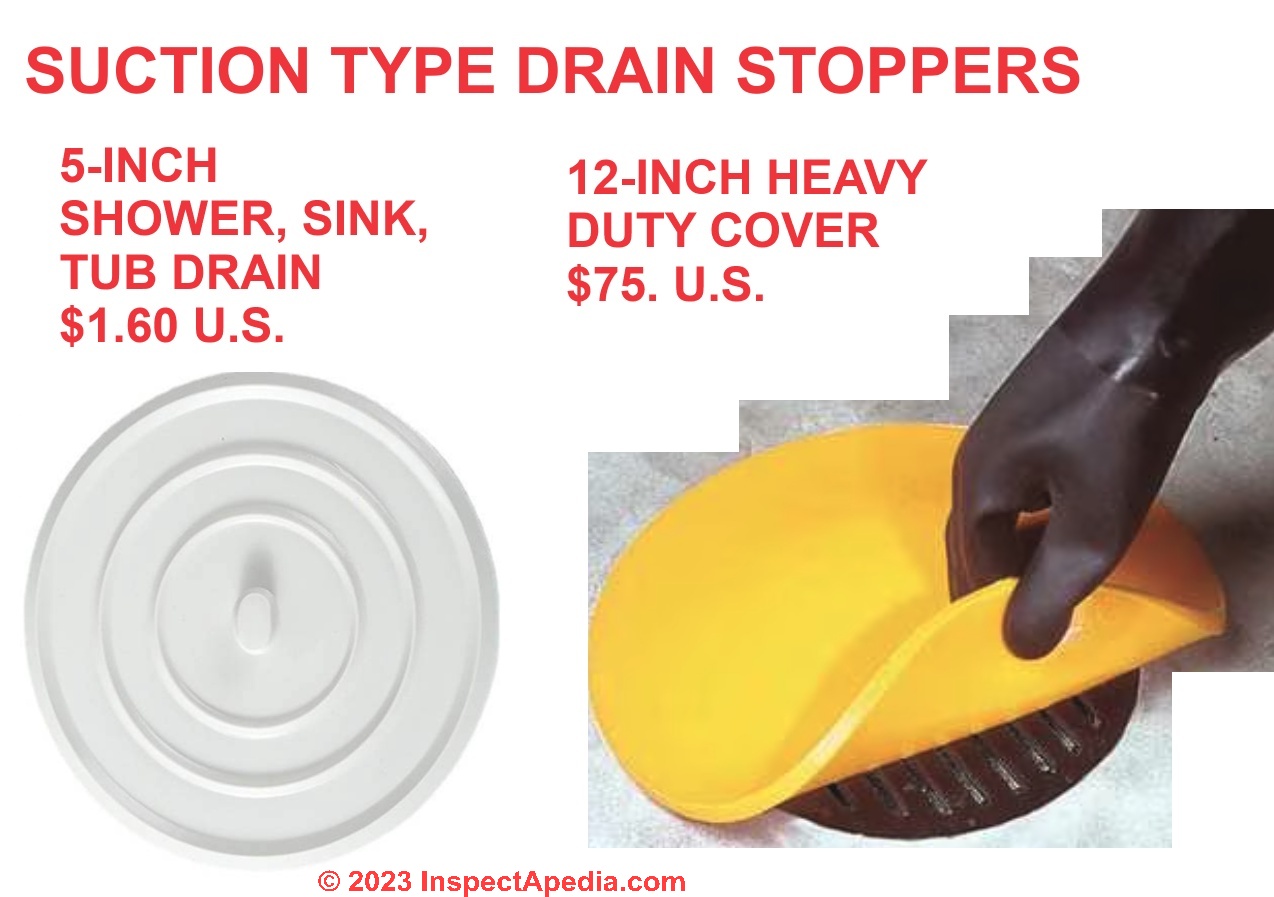
- Buy a simple rubber or silicone sinktubshower or floor drain cover like the 5-inch suction type drain seal shown above. These drain seals are held in place by gravity or by "suction" if other building drains are causing "suction" to occur at this drain.
These sinktubshower or floor drain covers or seals are sold at local plumbing and hardware stores as well as by online vendors.
Watch out: if other drains in the building are causing suction at a floor drain we suspect that the building's drain vent system is improperly-constructedmissingor blocked. If sewer gases are being drawn into your building there are both health and exposion risks.
See details at METHANE & SEWER GAS HAZARDS
and
at PLUMBING VENT DEFECTS & NOISES - Commercial and heavy duty or large floor drains might require the much more expensive 12-inch heavy duty silicone floor drain cover shown at right in our illustration above.
Floor Drain Trap Add-Ons or Replacements to Prevent Floor Drain Odors

- ProSet TrapGuard from ProvVent Systems,(shown above) a floor trap seal device designed to prevent sewer gas and sewage backups through the drain system. ProVent Systems Inc.
1355 Capital Circle
LawrencevilleGA30043Tel: 800-262-5355Website: http://proventsystems.com/
Excerpt from product description:
The Trap Guard is normally in the closed positionsealed tight like no other system. It opens with as little as one ounce of water but will allow a flow of 34.5 GPM of waste water when opened.
The Trap Guard has been tested in accordance with the ASSE 1072 test standard for ANSl/ASME A112.6.3 drains and by Warnock Hersey for the CSA B79 General Purpose Drains.
It was evaluated by the ICC Evaluation Service and listed under ICC-ES-PMG Listing 1091. The Trap Guard is accepted as a code approved alternate to using a Trap Primer. Primers have been used for many years using various type devices.
The problem is they usually stop working after a short period of time because of numerous water related mechanical problems. The Trap Guard has no mechanical moving parts and provides a 10 year limited warranty. - GreenDrainThe GreenDrain touted in an article comment by David is a floor drain-trap that allows water to pass from the floor into the drain system while blocking emission of sewer gases. Tel: 866-444-0212 Email: [email protected] Web: greendrains.com
- QUAD CLOSE TRAP SEAL DEVICE (Fig. # 2692) [PDF] from Sink StopperExcerpt from product description: The Quad Close Trap Seal Device creates a watertight
seal inside the drain and/or throat of the strainer.
It will stay open when water is flowing into the floor drain. It will close when the water stops flowing. When closedthe Quad Close prevents the emission of sewer gasesminimizes the evaporation of water in the trapand helps prevent backup into a building.
The purpose of the Quad Close device is to minimize the evaporation of the trap seal for the floor drain.
It will open to allow the flow of drainage and close when there is no flow. The trap seal is for use in the floor drain outlet or the throat of adjustable strainers.
Available from J.R. Smith Manufacturing Co.Plumbing & Drainage ProductsPO Box 3237Montgomery AL 36109USATel: 800-467-6484 - Sioux-Chief 2-inch or 3-inch WeldOne™ floor drains incorporate a floor drain with a trap primer port - illustrated below. Website: http://www.siouxchief.com/

- SureSeal 3-inch in-floor Drain Trap Seal (About $50.) This is a waterlessin-line floor drain trap seal with backwater protection to prevent both sewer gas escape through the floor drain and sewer backups through the floor drain.
Available from various sources including RectorSeal®2601 Spenwick Dr.Houston TX 77055USATel: 713-263-8001Website: http://www.rectorseal.com/sureseal-plus/
Excerpt from product manufacturere's description (Amazon 2016/06/06)
SureSeal 3" Floor Drain Trap Sealer meets the stringent new ASSE 1072 plumbing code standard for all floors and all floor drain flow rates. Patented engineered design creates no effective restriction on water flow.
Every SureSeal product meets or exceeds all code requirements. SureSeal blocks dangerous and noxious sewer gas emissions from backing-up into living or working areas.
SureSeal's Space-Age elastomeric neoprene material has been proven in plumbing industry uses for forty years and has been used in non-plumbing critical applications for almost fifty years of continuous use without degradation.
Successfully tested with common cleaning solutions and other chemicals approved from drain disposal. Functions despite lodging of common debris (mop stringsfood residueetc.).
InspectAPedia is an independent publisher of buildingenvironmentaland forensic inspectiondiagnosisand repair information provided free to the public - we have no business nor financial connection with any manufacturer or service provider discussed at our website. We do not sell products nor services.
Research on Self Sealing & Elastomeric Check Valves
- DickensonT. Christopher. ValvesPipingand Pipelines Handbook. Elsevier1999.
- LeeJoseph HWDavid L. Wilkinsonand Ian R. Wood. "On the head-discharge relation of a" duckbill" elastomer check valve." Journal of Hydraulic Research 39no. 6 (2001): 619-627.
- LeeJoseph HWJaydeep Karandikarand Peter R. Horton. "Hydraulics of “duckbill” elastomer check valves." Journal of Hydraulic Engineering 124no. 4 (1998): 394-405.
- Also see CHECK VALVES on DRAINSSEWAGE PUMPSSUMP PUMPS
...
Reader CommentsQuestions & Answers About The Article Above
Below you will find questions and answers previously posted on this page at its page bottom reader comment box.
Reader Q&A - also see RECOMMENDED ARTICLES & FAQs
Test by Pouring Water Down Floor Drain: flies in my cold room drain pipe?
 Noticed some drain flies in my cold room drain pipewe poured hot water down there and noticed a strong stench only after pouring the water and there appeared to be some form of back flow or blockage.
After pouring more water down the blockage appears to have subsided and can only see murky water now.
Any ideas what this could be? It’s a newer development.
Attached pics for reference. - On 2022-10-16
by Sam
-
Reply by InspectApedia (Editor) - diagnose & solve floor drain clog problems
@Sam
Solving the mystery of clogsbackupsor odors from floor drains like that in your photo really depends on finding out the routing of the drain line: where does it goand to what other drains is it connected.
Some floor drains connect to
- the building sewer or waste piping - so a floor drain backup could be due to a sewer blockage or septic failure
- the buildings footing drain system - a clog or floor drain backup can be difficult to clear if the footing drains themselves have failed
- a drain line leading to daylight outside the building ( IMO the best solution) - a floor drain clog might be cleared using a drain snake or similar clog clearer
- (less-common) a basement or crawl space sump pump system - a floor drain backup could be due to sump pump system failure
In a "newer development" as you describe itI don't know which of theseor some other routingapplies.
The fact that you see standing water in the drain that could be quite normalif the floor drain includes a trap
or
it could indicate that there is still a drain line blockage if there is no trap.
If you can pour an ample supply of water into the drain and it accepts it readily without backing up then the drain may be cleared.
If not I'd try a plumbing snake.
See if you can find out how this drain was installed and to what destination it's routedand let me know.
As an aside: am I right that there is a small-diameter plastic or copper tube emptying into this drain? Is that from an A/C or heat pump condensate drain?
...
Continue reading at PLUMBING SYSTEM ODORS or select a topic from the closely-related articles belowor see the complete ARTICLE INDEX.
Or see FLOOR DRAIN ODOR DIAGNOSIS FAQs - Q&A about floor drain smells or odors posted originallyi at this page
Or see these
Recommended Articles
- CAST IRON DRAIN LEAKODORREPAIR - diagnose sewer odors due to a broken under-floor sewer line
- CHECK VALVES on DRAINSSEWAGE PUMPSSUMP PUMPS
- SEWAGE PUMP ODORS
- SEWER GAS ODORS - home
- SEWER GAS ODOR REMEDIES
Suggested citation for this web page
FLOOR DRAIN / TRAP ODORS at InspectApedia.com - online encyclopedia of building & environmental inspectiontestingdiagnosisrepair& problem prevention advice.
Or see this
INDEX to RELATED ARTICLES: ARTICLE INDEX to PLUMBING SYSTEMS
Or use the SEARCH BOX found below to Ask a Question or Search InspectApedia
Ask a Question or Search InspectApedia
Try the search box just belowor if you preferpost a question or comment in the Comments box below and we will respond promptly.
< type="text/css">@import url(https://cse.google.com/cse/api/branding.css);Search the InspectApedia website
Note: appearance of your Comment below may be delayed: if your comment contains an imagephotographweb link, or text that looks to the software as if it might be a web linkyour posting will appear after it has been approved by a moderator. Apologies for the delay.
Only one image can be added per comment but you can post as many commentsand therefore imagesas you like.
You will not receive a notification when a response to your question has been posted.
Please bookmark this page to make it easy for you to check back for our response.
IF above you see "Comment Form is loading comments..." then COMMENT BOX - countable.ca / bawkbox.com IS NOT WORKING.
In any case you are welcome to send an email directly to us at InspectApedia.com at [email protected]
We'll reply to you directly. Please help us help you by notingin your emailthe URL of the InspectApedia page where you wanted to comment.
Citations & References
In addition to any citations in the article abovea full list is available on request.
- In addition to citations & references found in this articlesee the research citations given at the end of the related articles found at our suggested
CONTINUE READING or RECOMMENDED ARTICLES.
- CarsonDunlop & Associates Ltd., 120 Carlton Street Suite 407Toronto ON M5A 4K2. Tel: (416) 964-9415 1-800-268-7070 Email: [email protected]. Alan Carson is a past president of ASHIthe American Society of Home Inspectors.
Thanks to Alan Carson and Bob Dunlopfor permission for InspectAPedia to use text excerpts from The HOME REFERENCE BOOK - the Encyclopedia of Homes and to use illustrations from The ILLUSTRATED HOME .
Carson Dunlop Associates provides extensive home inspection education and report writing material. In gratitude we provide links to tsome Carson Dunlop Associates products and services.
 |
HOME | ABOUT | ASK a QUESTION | CONTACT | CONTENT USE POLICY | DESCRIPTION | POLICIES | PRIVACY | |
| © 2026 - 1985 Publisher InspectApedia.com - Daniel Friedman | |||||||||