


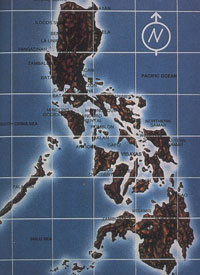
Location
The Philippines is located in Southeast Asiaon the eastern rim of the Asiatic Mediterranean. It is bounded in the west by the South China Sea; in the east by the Pacific Ocean; in the south by the Sulu and Celebes Seas; and in the north by the Bashi Channel. Its capital and main port of entry is Manila. Cebuwhich is some 562 kilometers to the south of Manilais the second largest international gateway to the country.
|
H) |
Land Area
The Philippines is an archipelago consisting of 7,100 islands with a total land area of approximately 300,000 square kilometers. It has three major island groups-Luzon in the northVisayas in the middle and Mindanao further down in the South.
Population
The current population of the Philippines is about 80 million people. Filipinos are basically of Indo-Malay racial stockmixed with some Chinese and Spanish ancestry.
Climate
The country has a tropical climate with two distinct seasons-wet and dry.
|
|
Language
The national language is Filipinowhich is based on the language of Tagalogalthough there are at least one or two dialects spoken in every region. There are more than 87 languages and dialects in the country. English is considered an official language as it is both spoken and understood throughout the Philippines and used in businessgovernment and schools.
Religion
More than 80% of the population is Roman Catholic. Other major religions include Muslim and Protestant.
Literacy
The literacy rate in the country is 92.6%
Monetary Unit
The unit of currency is the Philippine peso. The rate of the peso to the US dollar has been fluctuating between P50-P54 to the US dollar.
Brief History of the Philippines
Early History
Historians believe the Philippines dates back to the Paleolithic age. Based on the archaeological artifacts recoveredFilipino society and culture were fairly developed prior to contacts with other countries.
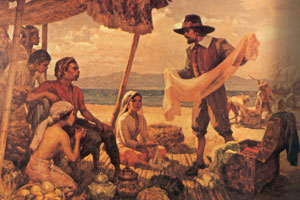
Filipinos had commercial relations early on with ChinaIndo-ChinaMalaysiaIndia and Arab countries. Chinese silkporcelainjarsgold ivoryand beads were traded for waxbird's nestteakwoodrattanpearlsprecious stones and other marine and forest products.
 |
|
Ancestors of present-day Filipinos were already trading with the outside world |
Spanish Colonial Period
Ferdinand Magellan came to the Philippines on March 161521 and claimed the country for the Spanish crown. A colonial government was established in Manila in 1571. Spain introduced changes in the politicalsocial and cultural life of the people. One of these is Christianity.
In 1896the Filipinos staged the first nationalistic revolution in Asia against the Spaniards. The 1896 Revolution was the culmination of revolts against Spanish oppression. The death by musketry of Dr. Jose Rizal who led the reform movement fueled the fires of revolution.
On June 121898leaders of the revolution declared the country a sovereign state and proclaimed the first Republic of the Philippines. MeanwhileSpain declared war against the United States over Cuba and was defeated. As an offshootthe Philippines were ceded to America by Spain through the Treaty of Paris.
 |
| The EDSA People Power revolution restored democracy in the Philippines |
The American Era
Under the Americansagriculturecommerce and trade rapidly developed. Among the changes they introduced were: the modernization of transportation and communicationthe improvement of banking and currencythe American system of educationliteraturelanguagearts and sciences. During the outbreak of the Second World WarJapan occupied the country. In 1945the Americans liberated the country and granted it Independence on July 41946.
People Power
In 1972Martial Law was declared by then President Ferdinand Marcos. Political repression and economic deterioration during the Martial Law years resulted in the historic "People Power" Revolution on February 251986. This led to the proclamation of Corazon C. Aquino as President of the Philippines. Still one of the strongest democracies in Asiathe current president is Benigno S. Aquino III.
The Government Today
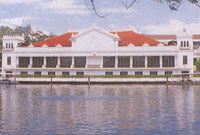 |
| Malacanang Palace is where Philippine Presidents hold office |
Presidential Form of Government
The Philippines today is a democratic and republican state with a presidential form of government as provided under the 1987 Philippine Constitution. Separation of powers are ensured through checks and balances among the three branches of government; the Executiverepresented by the President and his/her Cabinet; the Legislativerepresented by a Bicameral Congress composed of the Senate and the House of Representatives; and the Judiciarywith the power of judicial review.
|
|
|
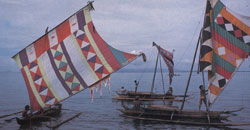
Colorful vintas ply the waters of the Autonomous Region in Muslim Mindanao |
Autonomous Muslim Mindanao Region
One of the country's uniquely decentralized local governments is the Autonomous Region for Muslim Mindanao (ARMM). The ARMM was created by law to allow the four provinces of Tawi-TawiSuluLanao del Sur and Maguindanao in the southern island of Mindanao to have an autonomous regional government. As an autonomous government unitthe ARMM is authorized to initiate and attract direct foreign investments for the development and growth of its mainly Muslim population.
Philippine Center Building | 556 5th Avenue
New YorkNY 10036 | (Between 45th and 46th)
Tel:(212)764-1300 | Fax:(212)840-8602 | E-mail: [email protected]