
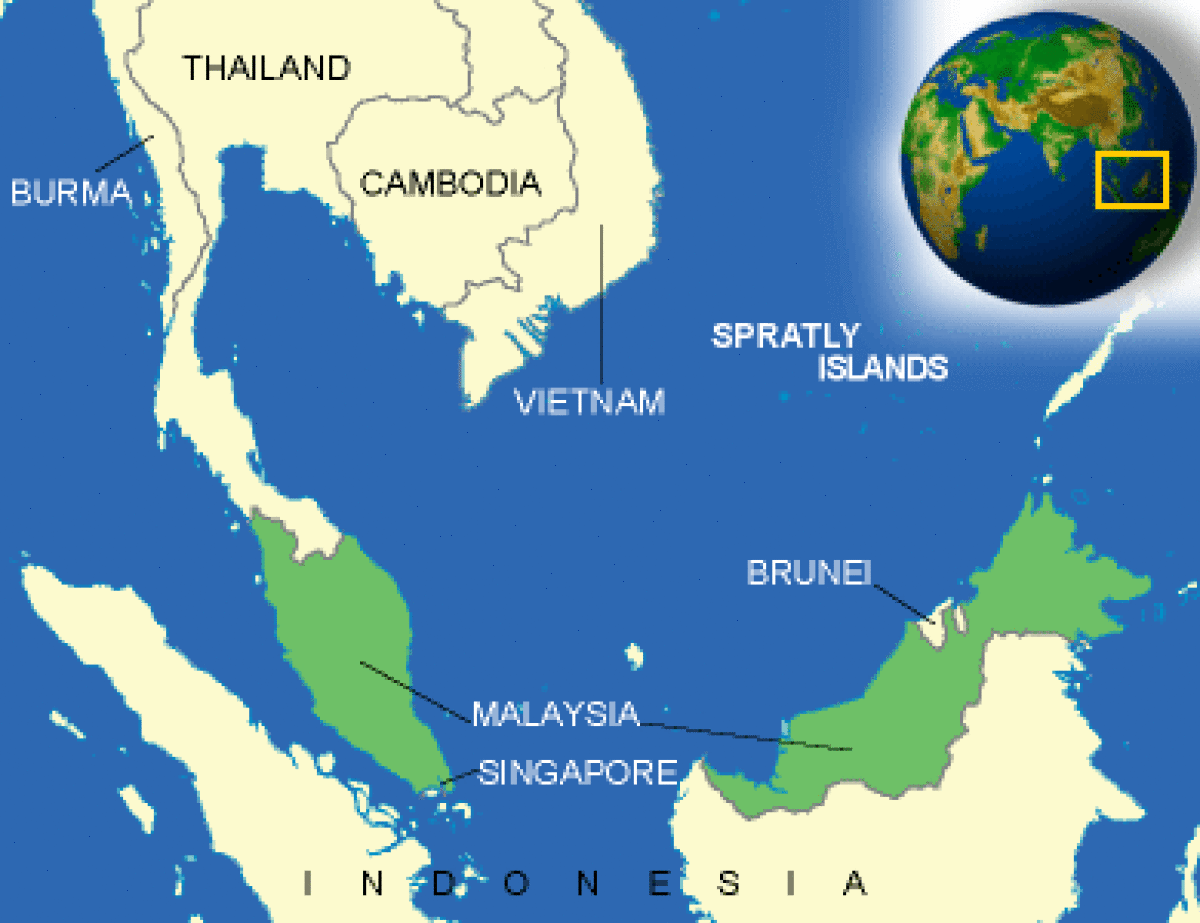
Where is Malaysia?
What countries border Malaysia?
Malaysia Weather
What is the current weather in Malaysia?
Malaysia Facts and Culture
What is Malaysia famous for?
- Cultural Attributes: A person's ancestral background is often important to social status and future opportunities. More
- Family: Traditionallythe family system is the most important social unit in Malaysia. It is common for two or more generations... More
- Personal Apperance: Most people wear Western- clothing. Howevertraditional clothingor a combination of Western and traditional clothingis also worn. Special... More
- Recreation: Silat is the Malay art of self-defensewhich is performed in such a stylized waywith controlled yet fluid movements,... More
- Diet: A wide variety of foods are eaten. Rice is the main food and fish is the main source of protein.... More
- Food and Recipes: Malays eat with spoons and use hands as well. Some cultural groups refrain from eating certain foods. For exampleMuslims... More
- Visiting: Visiting one's relatives and friends is important especially when one does not share a house with the extended family.... More
- Dating: Dating and marriage practices in urban areas are similar to those in other Westernized countries. Attitudes are more liberal. Families... More
Malaysia Facts
What is the capital of Malaysia?
| Capital | Kuala Lumpur; note - nearby Putrajaya is referred to as a federal government administrative center but not the capital; Parliament meets in Kuala Lumpur |
| Government Type |
federal parliamentary constitutional monarchy note: all Peninsular Malaysian states have hereditary rulers (commonly referred to as sultans) except Melaka (Malacca) and Pulau Pinang (Penang); those two states along with Sabah and Sarawak in East Malaysia have governors appointed by government; powers of state governments are limited by the federal constitution; under terms of federationSabah and Sarawak retain certain constitutional prerogatives (e.g.right to maintain their own immigration controls) |
| Currency | Malaysian Ringgit (MYR) |
| Total Area |
127,354 Square Miles 329,847 Square Kilometers |
| Location | Southeastern Asiapeninsula bordering Thailand and northern one-third of the island of Borneobordering IndonesiaBruneiand the South China Seasouth of Vietnam |
| Language | Bahasa Melayu (official)EnglishChinese dialects (CantoneseMandarinHokkienHakkaHainanFoochow)TamilTeluguMalayalamPanjabiThai |
| GDP - real growth rate | 4.7% |
| GDP - per capita (PPP) | $26,600.00 (USD) |
Malaysia Demographics
What is the population of Malaysia?
| Ethnic Groups | Malay and other indigenous 58%Chinese 24%Indian 8%others 10% |
| Nationality Noun | Malaysian(s) |
| Population | 32,652,083 |
| Population Growth Rate | 1.51% |
| Population in Major Urban Areas | KUALA LUMPUR (capital) 1.556 million; Klang 1.19 million; Johor Bahru 1.045 million |
| Urban Population | 72.800000 |
Malaysia Government
What type of government does Malaysia have?
| Suffrage | 18 years of age; universal (2019) |
| Citizenship |
citizenship by birth: no citizenship by descent only: at least one parent must be a citizen of Malaysia dual citizenship recognized: no residency requirement for naturalization: 10 out 12 years preceding application |
| National Holiday | Independence Day (or Merdeka Day)31 August (1957) (independence of Malaya); Malaysia Day16 September (1963) (formation of Malaysia) |
| Constitution |
history: previous 1948; latest drafted 21 February 1957effective 27 August 1957 amendments: proposed as a bill by Parliament; passage requires at least two-thirds majority vote by the Parliament membership in the bill’s second and third readings; a number of constitutional sections are excluded from amendment or repeal; amended many timeslast in 2019 |
| Independence | 31 August 1957 (from the UK) |
Malaysia Video
YouTube: TrekkingThePlanet Experience the Wild Side of Penang IslandMalaysia
CountryReports YouTube Channel:
Join CountryReports YouTube Channel (Click Here)Malaysia Geography
What environmental issues does Malaysia have?
| Overview |
Peninsular Malaysia extends south for 800 kilometers from Thailand’s Isthmus of Kra to Singapore and the Indonesian Archipelago. Sabah and Sarawakthe States of East Malaysia lie 600 kilometers to the east across the South China Sea. These two Statesformer British colonies on the northeast coast of Borneostretch for 1,000 kilometers to the southern islands of the Philippines. A central mountain range with peaks rising to 2,100 meters divides Peninsular Malaysia. Scenic coastal plains lie on either side of the mountains; most of the population lives in the plains and foothills of the western coast along the Straits of Malacca. The eastern coastalong the South China Seahas beautiful whitesandy beachesbut fewer people. Between the two coasts lie the mountains and an often-impenetrable jungle. Primary forest covers 60% of Malaysia and contains a variety of flowering plants and immensebut now diminishingtimber reserves. Vegetationeven in the citiesis lush and tropical. Forest wildlife includes gibbons; tigers; elephants; mouse deer; countless species of birdsmonkeys and insects; andin Sabah and Sarawakthe orangutan. |
| Climate |
The weather in Kuala Lumpur varies little throughout the year. Daily minimum and maximum temperatures remain fairly constant averaging 27°C (80°F) and 38°C (100°F). With the heatthere is high humidity as the average annual rainfall is 250 centimeters. Although Kuala Lumpur is not subject to typhoons or cyclonesbrief rainy seasons occur each year and bring scattered flooding. About 1-2 months of relatively dry weather usually precede the rainy seasonsalthough afternoon and evening thundershowers occur regularly throughout the year. The east coast and East Malaysia experience longer rainy seasonsand more widespread flooding as a result. |
| Border Countries | Brunei 381 kmIndonesia 1,782 kmThailand 506 km |
| Environment - Current Issues | air pollution from industrial and vehicular emissions; water pollution from raw sewage; deforestation; smoke/haze from Indonesian forest fires |
| Environment - International Agreements |
party to: BiodiversityClimate ChangeClimate Change-Kyoto ProtocolDesertificationEndangered SpeciesHazardous WastesLaw of the SeaMarine Life ConservationOzone Layer ProtectionShip PollutionTropical Timber 83Tropical Timber 94Wetlands signedbut not ratified: none of the selected agreements |
| Terrain | coastal plains rising to hills and mountains |
Malaysia Economy
How big is the Malaysia economy?
| Economic Overview |
Malaysiaan upper middle-income countryhas transformed itself since the 1970s from a producer of raw materials into a multi-sector economy. Under current Prime Minister NAJIBMalaysia is attempting to achieve high-income status by 2020 and to move further up the value-added production chain by attracting investments in high technologyknowledge-based industries and services. NAJIB's Economic Transformation Program is a series of projects and policy measures intended to accelerate the country's economic growth. The government has also taken steps to liberalize some services sub-sectors. Malaysia is vulnerable to a fall in world commodity prices or a general slowdown in global economic activity. The NAJIB administration is continuing efforts to boost domestic demand and reduce the economy's dependence on exports. Domestic demand continues to anchor economic growthsupported mainly by private consumptionwhich accounts for 53% of GDP. Neverthelessexports - particularly of electronicsoil and gasand palm oil - remain a significant driver of the economy. In 2015gross exports of goods and services were equivalent to 73% of GDP. The oil and gas sector supplied about 22% of government revenue in 2015down significantly from prior years amid a decline in commodity prices and diversification of government revenues. Malaysia has embarked on a fiscal reform program aimed at achieving a balanced budget by 2020including rationalization of subsidies and the 2015 introduction of a 6% value added tax. Sustained low commodity prices throughout the period not only strained government financesbut also shrunk Malaysia’s current account surplus and weighed heavily on the Malaysian ringgitwhich was among the region’s worst performing currencies during 2013-17. The ringgit hit new lows following the US presidential election amid a broader selloff of emerging market assets. Bank Negara Malaysia (the central bank) maintains adequate foreign exchange reserves; a well-developed regulatory regime has limited Malaysia's exposure to riskier financial instrumentsalthough it remains vulnerable to volatile global capital flows. In order to increase Malaysia’s competitivenessPrime Minister NAJIB raised possible revisions to the special economic and social preferences accorded to ethnic Malays under the New Economic Policy of 1970but retreated in 2013 after he encountered significant opposition from Malay nationalists and other vested interests. In September 2013 NAJIB launched the new Bumiputra Economic Empowerment Programpolicies that favor and advance the economic condition of ethnic Malays. Malaysia signed the 12-nation Trans-Pacific Partnership (TPP) free trade agreement in February 2016although the future of the TPP remains unclear following the US withdrawal from the agreement. Along with nine other ASEAN membersMalaysia established the ASEAN Economic Community in 2015which aims to advance regional economic integration. |
| Industries | Peninsular Malaysia - rubber and oil palm processing and manufacturinglight manufacturing industryelectronicstin mining and smeltinglogging and processing timber; Sabah - loggingpetroleum production; Sarawak - agriculture processingpetroleum production and refininglogging |
| Currency Name and Code | Malaysian Ringgit (MYR) |
| Export Partners | US 20.2%Singapore 17.1%Japan 11.3%Hong Kong 5.7%China 5.6%Thailand 4.3% |
| Import Partners | Japan 17.8%US 16.5%Singapore 12%China 7.7%Taiwan 5.6%South Korea 5.3%Thailand 4% |
Malaysia News and Current Events
What current events are happening in Malaysia?
Source: Google News
Malaysia Travel Information
What makes Malaysia a unique country to travel to?
Country Description
Malaysia is a constitutional monarchy with an elected federal parliamentary government. The country comprises 13 states11 on the Malay Peninsula and twoSabah and Sarawakon the island of Borneo. There are also three federally administered territories: the capital city of Kuala Lumpurthe administrative center of Putrajayaand the island of Labuan. Malaysia is a multi-ethnic country of 27 million people. Malays form the predominant ethnic group; the two other large ethnic groups are Chinese and Indians. Islam is the official religion and is practiced by some 60 percent of the population. Bahasa Malaysia is the official languagealthough English is widely spoken. Travelers to Malaysia may access information on areas of interest through the Malaysian government's website and Tourism Malaysia's website.
Crime
Petty theftparticularly purse snatching and pick-pocketingand residential burglaries are the most common crimes committed against foreigners. Other types of non-violent criminal activity include credit card fraud and automobile theft. In tourist areas such as Bukit BintangPetaling Street (Chinatown)Sri Hartamasand Bangsar in Kuala Lumpurand the main square in Malaccathe police have established small "Tourist Police” stations familiar with helping visitors to Malaysia.There have been recent incidents of violent crime perpetrated against foreign tourists and local residents by taxi drivers in downtown Kuala Lumpur. Single women travelers are advised to book taxis in downtown shopping areas by phonerather than to hail taxis on the streetparticularly after dark. Upon entering a taxiconfirm there is a license (with photo) on the dashboard or seatbackand that the driver's appearance matches the photo. Taxis are not permitted to stop to pick up additional passengers. Some driversparticularly in tourist areasrefuse to use the meter despite a law prohibiting the practice.
SPADthe government body regulating taxis in Malaysiahas an English language hotline for reporting problems: 1-800-88-7732,
Scams: U.S. citizens and businesses continue to be the victims of scams originating in Malaysia. Scammers and confidence artists contact U.S. citizens through the telephone and Internetincluding dating websites. Scammers almost always pose as U.S. citizens who have unexpectedly experienced a medicallegalfinancial or other type of “emergency” in Malaysia and who ask the U.S. citizen in the United States to send money quickly to Malaysia. Co-conspirators pose as Malaysian lawyers or medical professionals to verify the story and the supposed urgent need for cash. There have also been cases of U.S. businesses being defrauded by faulty investment scams. We strongly urge U.S. citizens in the United States to be very cautious about sending money to people they have not met in person and who claim to be U.S. citizens in trouble in Malaysia. If you insist on sending moneyconsider sending an OCS Trust though the U.S. Department of State instead of direct Western Union or MoneyGram. OCS trusts are deposited directly with the nearest U.S. embassy and consulate overseas for pick up by verification of an I.D. If you are scammed and wish to make a formal complaint (in person or via e-mail)the Malaysian Embassy or the nearest Malaysian consulate in the United States will accept the complaint and transmit it to the police for follow-up. Resources on how to identifyprotect yourselfand report on business and financial fraud can be found in the Department of State's publicationInternational Financial Scams. Additional resources can be found at StopFraud.gov (a service of the Financial Fraud Enforcement Task Force) and from the U.S. Commodity Futures Trading Commission.
Purse Snatchings: In most purse-snatching incidentstwo thieves on a motorcycle speed up from behind a victimand the passenger on the back snatches a pursehandbagor cellular phone. Thieves have also conducted snatch-thefts while leaning out of the passenger side of moving vehicles. Increasinglyrobbers confront a victim in larger groups. These types of thefts can occur at all hours and often in front of large groups of witnesseseven in upscale neighborhoods frequented by expatriates. Women walking by themselves or with small children are the most common targetsbut men walking or jogging alone have also been targeted. Victims have been injured and even killed after falling and being dragged by thieves in cars or on motorcycles. More recentlysome thieves carrying knives have slashed and cut the victim in order to shock the victim into immediately releasing valuable items.
To avoid becoming the victim of a purse snatchingbe alert and aware of your surroundings. Pedestrians should walk facing traffic and keep a close eye on all vehicular trafficparticularly motorcycles. If possibletry to walk on the sidewalk away from the curb. Avoid poorly lit streetsshortcutsand narrow alleysbut be aware that attacks may still occur anywhere. Purses or shoulder bags should be closed and tucked under the arm. Do not wrap the strap around your arm or shoulder. People have been injured or killed by being pulled to the ground by their purse straps as the thieves sped off. If your purse or bag is snatchedreport the incident as soon as possible to the police.
Smash-and-Grab Robberies: The targets of smash-and-grab robberies are motorists who are stuck in traffic or stopped at a light. The usual scenario is that a pair of thieves on a motorcycle identifies a car with a lone passenger (male or female) and with valuables (e.g.pursebag) visible. The thieves use a hammer or crowbar to smash the window of the cargrab the bagand speed off. If the motorist's windows are already openthe motorcyclists simply reach in and take bags off the seat of the car. You can prevent these crimes by keeping valuables like purses and laptops out of sight while driving or removing them from the car (including from the trunk) when parked. GPS monitors should not be left on the windscreen or dashboard.
Credit Card Fraud: While traveling in Malaysia you should closely safeguard your credit card numbers at all timesand use the cards only at reputable establishments. Credit card fraud continues to be a problem in the regionalthough enhanced technology has reduced reported instances of fraud. Unauthorized charges may not show on a credit card account for several months but can unexpectedly appear in amounts of $5,000 or more. One of the more common methods of carrying out this fraud is for retailers to swipe the credit card under the counter where a machine containing a mobile phone SIM card receives the card's information and transmits it to a criminal organization for reproduction. You should watch retailers closely and any “under the table” transactions should be reported to the local police. In some casessophisticated criminal organizations have tapped into data lines emanating from retail establishments. The criminals then steal the credit card information while it is being transmitted to financial institutions. If you must use a credit card in Malaysiayou should check your account information frequently for fraudulent charges. ATM cards are safer as long as the machines where they are used are associated with reputable Malaysian banks.
Don't buy counterfeit or pirated goodseven if they are widely available. Not only are the bootlegs illegal in the United Statesyou are encouraging criminal activity if you buy them.
Criminal Penalties
While you are traveling in Malaysiayou are subject to its laws even if you are a U.S. citizen. Foreign laws and legal systems can be vastly different than our own. In some places you may be taken in for questioning if you don't have your passport with you. In some placesit is illegal to take pictures of certain buildings. In Malaysiadriving under the influence could land you immediately in jail.These criminal penalties will vary from country to country. There are also some things that might be legal in the country you visitbut still illegal in the United Statesand you can be prosecuted under U.S. law if you buy pirated goods. Engaging in sexual conduct with children or using or disseminating child pornography in a foreign country is a crime prosecutable in the United States. If you break local laws in Malaysiayour U.S. passport won't help you avoid arrest or prosecution. It's very important to know what's legal and what's not wherever you go.If you violate the laweven unknowinglyyou may be finedexpelledarrestedor imprisoned. Malaysia strictly enforces its drug laws. If you possessuseor traffic in illegal drugs in Malaysiayou will be sentenced to significantly longer prison sentences and much heavier fines than in the United States. Malaysian legislation provides for a mandatory death penalty for convicted drug traffickers. If you are arrested in possession of 15 grams (1/2 ounce) of heroin or 200 grams (seven ounces) of marijuanayou will be presumed by law to be trafficking in drugs.
The Malaysian criminal code includes a provision for a sentence of caning for certain white-collar crimesincluding criminal misappropriationcriminal breach of trustand cheating. If you collect and/or remove local flora and fauna or protected species without authorization from the Malaysian governmentyou may be prosecuted criminally and may be sentenced to heavy finesexpulsionand/or imprisonment.
Distribution of religious leaflets or books of another faith to Malaysian Muslims is illegal; if you engage in this actionyou may be arrested and imprisoned. Occasionallyspecial religious authorities coordinate with local police to conduct raids on popular nightspots and hotels to deter activities among local Muslims that contravene religious customsincluding drinking alcohol and having premarital sex.
Arrest notifications in Malaysia: While some countries will automatically notify the nearest U.S. embassy or consulate if a U.S. citizen is detained or arrested in a foreign countrythat might not always be the case in Malaysia. To ensure that the United States is aware of your circumstancesrequest that the police and prison officials notify the U.S. Embassy as soon as you are arrested. You should carry your U.S. passport and current social visit pass (visa) with you at all timesso that if you are questioned by local officialsyou will have proof of your identityU.S. citizenshipand legal status in Malaysia readily available.
Medical Facilities and Health Information
Medical facilities and services are adequate in the larger citieswhere you can find Western-trained doctors. The U.S. Embassy can provide a list of English-speaking doctors and hospitals upon request. Psychological and psychiatric medical and counseling services are limited. Serious medical problems requiring hospitalization and/or medical evacuation to the United States can cost thousands of dollars or more. Doctors and hospitals often expect immediate cash payment for health servicesalthough major credit cards are acceptable at some hospitals in larger cities.Malaysian ambulance attendants do not have training equivalent to U.S. standards. Callers to Malaysia's "999" emergency number (equivalent to dialing 911 in the United States) are connected to the Red Crescent (a member of the International Federation of Red Cross and Red Crescent Societies)and patients are directed to whichever hospital the dispatcher chooses. If you are staying in Malaysia for a long timeand you have known health problemsyou should investigate private ambulance services in the area and provide family and close contacts with the direct telephone number(s) of the service you prefer.
Air quality in Malaysia is acceptable most of the time. Howeverwhen Malaysia and nearby countries burn vegetationespecially from March through June and during September and Octoberair quality can range from “unhealthy for sensitive groups” to “unhealthy.”
Safety and Security
The Department of State remains concerned about the possibility of terrorist attacks against U.S. citizens in Southeast Asia. Extremist groups in the region have demonstrated the capability to carry out attacks in locations where Westerners congregateand these groups do not distinguish between civilian and official targets. The U.S. government has designated two such groupsJemaah Islamiyah (JI) and the Abu Sayyaf Group (ASG)as Foreign Terrorist Organizations. JIwhich has a known presence in Malaysiais linked to al-Qaeda and other regional terrorist groups and has cells operating throughout Southeast Asia.U.S. citizens should consider the risks associated with travel to coastal eastern Sabah (Eastern Malaysia) due to the threat from both terrorist and criminal groups. Employees of the U.S. Embassy in Kuala Lumpur are prohibited from travelling to most of this area without prior permission from the security office and Ambassador. This permission requirement for U.S. embassy employees indicates a strong concern over safety.
U.S. citizens are accordingly advised against travel to the coastal resorts in Eastern Sabah. This area includes the beach areas of SandakanSemporna and Beluran Districtsresorts along the Kinabatangan River (Sukau District) and Sabahan River (Kunak Districtand the following resort islands: SelinganLankayanMabulPom PomKapalaiLigitanSipadanand Mataking. Kidnappings-for-ransom occur frequently in these areas. In mid-November 2013a foreign tourist was killed and his spouse was abducted from a resort on Pom Pom Island. In August 2013Malaysian officials reported an aborted attempt by an armed Filipino group to kidnap foreign tourists from the resort island of Mabul. In addition to incursions on the coastal or island resort islands themselvescriminal or terrorist bands may attempt to intercept boats ferrying tourists from the mainland to the resort islands.
U.S. citizens are also advised against travel to the peninsular Lahad Datu district (to include the Tabin Wildlife Reserve). In early February 2013armed intruders from the Sulu archipelagowho had entered the area by sea from the southern Philippineswere involved in a violent confrontation with Malaysian security forces in the district. The entire eastern portion of Sabah (extending from the town of Kudat in the north to Tawau district near the border of Indonesia) has been designated as the Eastern Sabah Security Zoneand an Eastern Sabah Security Command has been established to coordinate security forces' activity. There is a significant police and army presence in the areaand road checkpoints have increased. The Malaysian government has also enhanced efforts to patrol its maritime border with the Philippinesbut the size and remoteness of the coastal region makes it possible there may be future security incidents.
Most tourists travel directly (via transportation arranged by tour operators and hotels) from Lahad Datu airport to the resorts in the inland Danum Valley. If you plan travel to the areawe recommend you use direct transit arranged by reputable companies.
Traffic Safety and Road Conditions
While in Malaysiayou may encounter road conditions that differ significantly from those in the United States. The information below concerning Malaysia is for general reference only and may not be totally accurate in a particular location or circumstance.Many car rental agencies in Malaysia are willing to rent vehicles for a short term to U.S. citizens with valid U.S. driver's licenses. Neverthelessif you plan on driving in Malaysiawe strongly urge you to obtain an international driving permit (IDP) before leaving the United States. More information on how to obtain an IDP is available on the Road Safety Overseas section of the Department of State website. If you plan to stay in Malaysia for a longer period of timeyou must obtain a local driver's permit through the Road Transport Department of Malaysia.
Traffic in Malaysia moves on the left side of the roadand most vehicles are right-hand drive. Motorcyclists attempt to circumvent traffic blockage by weaving in and out of traffictemporarily using vacant oncoming traffic lanesand running through red lights. These practices pose a hazard for both drivers and pedestrians unfamiliar with such traffic patterns. If you driveyou should use your turn signals well in advance of turning to alert motorcycles of your intent to turn. By lawyou must use your front- and back - seat belts in Malaysia and may not use your cell phone while driving unless it is hands-free (e.g.Bluetooth.) Turning left at a red light is not legal unless otherwise marked.
Traffic is heavy during the morning and afternoon rush hours and slows down considerably when it rains. Monsoonal rains can quickly floods roads located in low-lying areas. Bottlenecks are common in major cities because infrastructure development has not kept pace with the proliferation of motorized vehicles. Multi-lane highways often merge into narrow two-lane roads in the center of town and cause added congestion. Many streets are narrow and winding.
There have been fatal and other serious accidents involving long-distance tour buses in Malaysiaparticularly at night or in adverse weather conditions. If you plan to travel by buschoose a reputable companyand avoid overnight itineraries.
Reports of late-night road rage incidentsespecially after midnightare rising. If you driveavoid confrontational behavior if you are involved in an accident. If you are threatenedleave the scene and file a report with the local police within 24 hours.
Taxis are meteredbut many drivers refuse to use the meter and instead charge a much higher rateparticularly during peak hourswhen it is rainingor when the passenger's destination is to or through a heavily congested area. By regulationmetered fares increase by 50 percent between midnight and 6 a.m.; meters are programmed to display the higher fee automatically during these hours.
Sobriety Checkpoints: Please note that laws against drinking and driving are strictly enforced and carry serious penalties. Police operate sobriety checkpoints in many entertainment districts frequented by expatriates. At these checkpointsall drivers must submit to alcohol breath tests. If you fail a breath testyou will be arrested.
Driver's License Requirements: International Driver's Licenses (IDL) may be used for 90 days in Malaysia. The IDL must be obtained outside of Malaysia. If you are staying longer than 90 days in Malaysiaand desire a local licensethe Malaysian Road Transport Department recommends contacting a local driving school to arrange all the paperwork. In order to obtain a local licenseyou will also need a valid work permit.