

Managing Dental Erosive Tooth Wear: Current Understanding and Future Directions
Course Number: 517
Course Contents
The Basic Erosive Wear Examination (BEWE)
The BEWEintroduced by BartlettGanss and Lussi in 2008,82 is used to assess the level of erosion. For this examinationthe mouth is divided into six distinct areas for evaluation. Table 6 shows the criteria for sextant scores from 0 to 3which are summed to obtain a cumulative score that is the basis for determining interventions (Table 7). The BEWE is a simplequick index for screening a patient’s erosion status.
Table 6. BEWE Scores and Criteria.
| Score | Criteria | Image |
|---|---|---|
| 0 | No ETW | 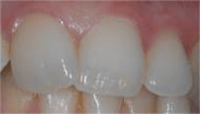 |
| 1 | Initial loss of surface texture | 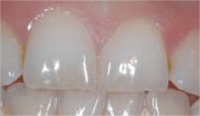 |
| 2a | Distinct defect; hard tissue loss involving <50% of the surface area | 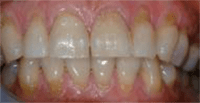 |
| 3a | Hard tissue loss involving ≥50% of the surface area | 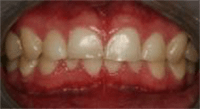 |
Dentin often involved.
Table 7. Cumulative BEWE Scores and Management Guidelines.
| Cumulative Score | General guidelines for management |
|---|---|
| No ETW: 0 - 2 |
|
| Low: 3 - 8 |
|
| Medium: 9 -13 |
|
| High: ≥14 |
|
0/26Next