
遗传 ›› 2022Vol. 44 ›› Issue (8): 635-654.doi: 10.16288/j.yczz.22-108
适应性演化的分子遗传机制:以高海拔适应为例
郝艳1雷富民1,2,3( )
)
- 1. 中国科学院动物研究所动物进化与系统学重点实验室,北京 100101
2. 中国科学院大学生命科学学院,北京 100049
3. 中国科学院动物进化与遗传前沿交叉卓越创新中心,昆明 650223
-
收稿日期:2022-04-13修回日期:2022-06-25出版日期:2022-08-20发布日期:2022-07-19 -
通讯作者:雷富民 E-mail:[email protected] -
作者简介:郝艳,博士,研究方向:鸟类适应性进化。E-mail:[email protected] ,2014—2020年就读于中国科学院动物研究所,在鸟类学研究组攻读博士学位,导师是雷富民研究员。目前在中国科学院动物研究所接受博士后训练,主要研究方向为鸟类对极端环境适应的分子机制。博士期间,在不同的鸟类演化体系中,采用比较基因组学、比较转录组学等研究方法,结合形态学等表型数据及功能实验验证,从位点、基因、基因家族、生物功能通路、基因表达等角度检测了鸟类对青藏高原极端环境适应的趋同和趋异信号,并探讨了鸟类适应演化的可能机制。已获得中国博士后科学基金一等面上资助项目、中国科学院特别研究助理资助项目、国家自然科学基金委青年科学基金项目及第七届中国科协青年人才托举工程项目。博士论文《三对近缘高低海拔雀形目鸟类的比较转录组学研究》获得2021年中国科学院优秀博士生论文。 -
基金资助:国家自然科学基金项目编号(321003323213000355);第二次青藏高原综合科学考察研究项目编号(2019QZKK0304);青年人才托举工程项目编号(2021QNRC001);中国博士后科学基金资助编号(2021M700144)
Genetic mechanism of adaptive evolution: the example of adaptation to high altitudes
Yan Hao1Fumin Lei1,2,3()
- 1. Key Laboratory of Zoological Systematics and EvolutionInstitute of ZoologyChinese Academy of SciencesBeijing 100101China
2. College of Life SciencesUniversity of Chinese Academy of SciencesBeijing 100049China
3. Center for Excellence in Animal Evolution and GeneticsChinese Academy of SciencesKunming 650223China
-
Received:2022-04-13Revised:2022-06-25Online:2022-08-20Published:2022-07-19 -
Contact:Lei Fumin E-mail:[email protected] -
Supported by:Supported by the National Natural Science Foundation of China Nos(321003323213000355);the Second Tibetan Plateau Scientific Expedition and Research (STEP) Program No(2019QZKK0304);the Young Elite Scientists Sponsorship Program by CAST No(2021QNRC001);the China Postdoctoral Science Foundation No(2021M700144)

摘要:
自达尔文时代起,解析适应性演化的机制一直是进化生物学和生态学领域研究最重要的科学问题之一。适应性演化通常指在自然选择驱动下,物种为提高适合度而演化出特定的表型。表型的适应表现在形态、生理生化、组织学、行为学等多个层级。随着分子生物学和测序技术的发展,越来越多的研究揭示了适应性复杂性状的遗传基础。研究适应性演化的分子遗传机制有助于理解塑造生物多样性的进化驱动力以及阐明基因型、表型和环境之间的关联关系。目前已有主效基因、超基因、多基因遗传、非编码区调控、重复序列调控、基因渐渗等多种假说可以解释适应性演化的遗传机制。高海拔极端环境的强选择压力极大地促进了物种表型和遗传适应的发生,对多组学数据的剖析为物种适应性演化提供了新的见解。本文对适应性演化的遗传机制、高海拔极端环境适应研究进展以及目前面临的主要挑战进行了综述,并对未来的发展趋势进行了展望,以期为该领域的科研人员提供参考。
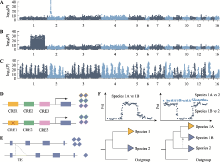
图1
适应性演化遗传机制 A:主效基因假说;B:超基因假说;C:多基因遗传假说;D:非编码区调控假说;E:重复序列调控假说;F:基因渐渗假说。CRE:cis-regulatory element;TE:transposable element。"
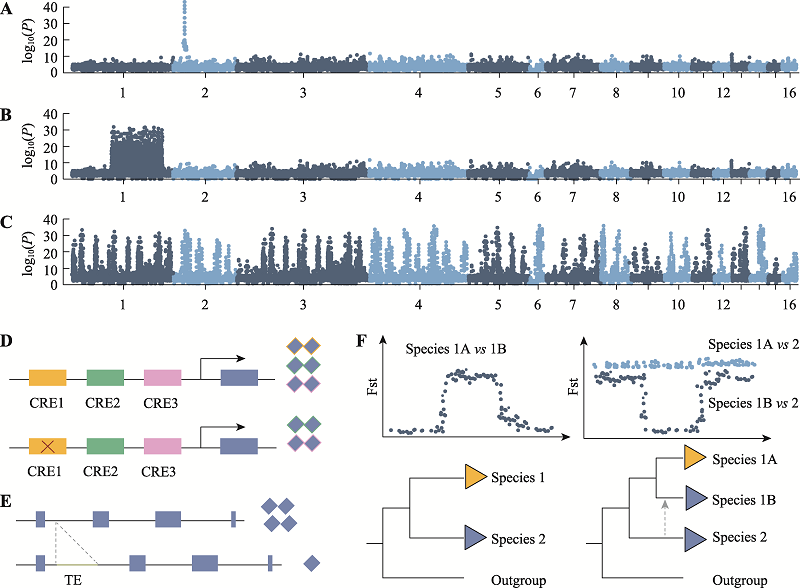
表1
高海拔适应研究的典型实例汇总"
| 类群 | 物种 | 测序技术 | 主要支持的假说 | 参考文献 |
|---|---|---|---|---|
| 人类 | 藏人(Homo sapiens) | Affymetrix 6.0 SNP Array | 主效基因假说 | [ |
| 藏人(Homo sapiens) | Illumina 610-Quad Genotyping Array | 主效基因假说 | [ | |
| 藏人(Homo sapiens) | Affymetrix 6.0 SNP Array和Illumina HiSeq (resequencing和RNA-seq) | 主效基因假说 | [ | |
| 藏人(Homo sapiens) | Illumina CoreExome Array | 主效基因假说 | [ | |
| 藏人(Homo sapiens) | Illumina HiSeq (RNA-seq、ATAC-seq、Resequencing和Hi-C) | 非编码区调控假说 | [ | |
| 藏人(Homo sapiens) | Illumina HiSeq (resequencing) | 基因渐渗假说 | [ | |
| 哺乳类 | 高原鼢鼠(Myospalax baileyi)和高原鼠兔(Ochotona curzoniae) | Illumina HiSeq (whole-genome sequencing) | 主效基因假说 | [ |
| 牦牛(Bos grunniens) | Illumina HiSeq (whole-genome sequencing) | 多基因遗传假说 | [ | |
| 滇金丝猴(Rhinopithecus bieti)、怒江金丝猴(Rhinopithecus strykeri )和川金丝猴(Rhinopithecus roxellana) | Illumina HiSeq (whole-genome sequencing、RNA-seq和resequencing) | 多基因遗传假说 | [ | |
| 藏灰狼(Canis lupus chanco) | Illumina HiSeq (resequencing) | 多基因遗传假说 | [ | |
| 高原鼢鼠(Myospalax baileyi) | Pacific Biosciences (PacBio) RS II (whole- genome sequencing)和Illumina HiSeq (whole- genome sequencing和resequencing) | 多基因遗传假说 | [ | |
| 藏獒(Canis lupus familiaris) | Illumina HiSeq (whole-genome sequencing) | 基因渐渗假说 | [ | |
| 鸟类 | 地山雀(Pseudopodoces humilis) | Illumina HiSeq (whole-genome sequencing) | 多基因遗传假说 | [ |
| 地山雀(Pseudopodoces humilis)、白眉山雀(Poecile superciliosus)、褐冠山雀(Lophophanes dichrous)和黑冠山雀(Periparus rubidiventris) | Illumina HiSeq (resequencing) | 多基因遗传假说 | [ | |
| 褐冠山雀(Lophophanes dichrous)、黑冠山雀(Periparus rubidiventris)和棕额长尾山雀(Aegithalos iouschistos) | Illumina HiSeq (RNA-seq) | 非编码区调控假说 | [ | |
| 白腰雪雀(Onychostruthus taczanowskii)、棕颈雪雀(Pyrgilauda ruficollis)和褐翅雪雀(Montifringilla adamsi) | Illumina HiSeq (whole-genome sequencing) | 多基因遗传假说 | [ | |
| 树麻雀(Passer montanus) | Illumina HiSeq (whole-genome sequencing和resequencing) | 多基因遗传假说 | [ | |
| 绿尾虹雉(Lophophorus lhuysii) | Illumina HiSeq (whole-genome sequencing) | 多基因遗传假说 | [ | |
| 黑颈鹤(Grus nigricollis) | Oxford Nanopore Technologies (ONT) PromethION (whole-genome sequencing)和Illumina HiSeq (whole-genome sequencing) | 多基因遗传假说 | [ | |
| 四川雉鹑(Tetraophasis szechenyii) | Illumina HiSeq (whole-genome sequencing) | 多基因遗传假说 | [ | |
| 鱼类 | 厚唇裸重唇鱼 (Gymnodiptychus pachycheilus) | Illumina HiSeq (RNA-seq) | 多基因遗传假说 | [ |
| 达里湖高原鳅(Triplophysa dalaica)、拟鲶高原鳅(Triplophysa siluroides)和硬刺高原鳅(Triplophysa scleroptera) | Illumina HiSeq (RNA-seq) | 多基因遗传假说 | [ | |
| 两栖类 | 高山倭蛙(Nanorana parkeri) | Illumina HiSeq (whole-genome sequencing) | 多基因遗传假说 | [ |
| 高山倭蛙(Nanorana parkeri)、棘臂蛙(Nanorana liebigii)和双团棘胸蛙(Nanorana phrynoides) | Illumina HiSeq (RNA-seq) | 多基因遗传假说 | [ | |
| 爬行类 | 青海沙蜥(Phrynocephalus vlangalii)、红尾沙蜥(Phrynocephalus erythrurus)和贵德沙蜥(Phrynocephalus putjatia) | Illumina HiSeq (RNA-seq) | 多基因遗传假说 | [ |
| 温泉蛇(Thermophis baileyi)、四川温泉蛇(Thermophis zhaoermii)和香格里拉温泉蛇(Thermophis shangrila) | Illumina HiSeq (whole-genome sequencing和resequencing) | 多基因遗传假说 | [ |
| [1] |
Svensson EIBerger D. The role of mutation bias in adaptive evolution. Trends Ecol Evol201934(5): 422-434.
doi: S0169-5347(19)30030-8 pmid: 31003616 |
| [2] | Darwin CR. On the Origin of Species by Means of Natural Selectionor the Preservation of Favoured Races in the Struggle for Life. London: John Murray1859. |
| [3] | Morgan T. The Scientific Basis of Evolution. London: Faber and FaberLtd.1932. |
| [4] | Nei M. Molecular Evolutionary Genetics. New York: Columbia University Press1987. |
| [5] |
Kimura M. Evolutionary rate at the molecular level. Nature1968217(5129): 624-626.
doi: 10.1038/217624a0 |
| [6] |
Nei M. Selectionism and neutralism in molecular evolution. Mol Biol Evol200522(12): 2318-2342.
doi: 10.1093/molbev/msi242 |
| [7] | Feng SHStiller JDeng YArmstrong JFang QReeve AHXie DChen GJGuo CXFaircloth BCPetersen BWang ZJZhou QDiekhans MChen WJAndreu-Sánchez SMargaryan AHoward JTParent CPacheco GSinding MHSPuetz LCavill ERibeiro ÂMEckhart LFjeldså JHosner PABrumfield RTChristidis LBertelsen MFSicheritz-Ponten TTietze DTRobertson BCSong GBorgia GClaramunt SLovette IJCowen SJNjoroge PDumbacher JPRyder OAFuchs JBunce MBurt DWCracraft JMeng GLHackett SJRyan PGJønsson KAJamieson IGda Fonseca RRBraun ELHoude PMirarab SSuh AHansson BPonnikas SSigeman HStervander MFrandsen PBvan der Zwan Hvan der Sluis RVisser CBalakrishnan CNClark AGFitzpatrick JWBowman RChen NCloutier ASackton TBEdwards SVFoote DJShakya SBSheldon FHVignal ASoares AERShapiro BGonzález-Solís JFerrer-Obiol JRozas JRiutort MTigano AFriesen VDalén LUrrutia AOSzékely TLiu YCampana MGCorvelo AFleischer RCRutherford KMGemmell NJDussex NMouritsen HThiele NDelmore KLiedvogel MFranke AHoeppner MPKrone OFudickar AMMilá BKetterson EDFidler AEFriis GParody-Merino ÁMBattley PFCox MPLima NCBProsdocimi FParchman TLSchlinger BALoiselle BABlake JGLim HCDay LBFuxjager MJBaldwin MWBraun MJWirthlin MDikow RBRyder TBCamenisch GKeller LFDaCosta JMHauber MELouder MIMWitt CCMcGuire JAMudge JMegna LCCarling MDWang BTaylor SADel-Rio GAleixo AVasconcelos ATRMello CVWeir JTHaussler DLi QYYang HMWang JLei FMRahbek CGilbert MTPGraves GRJarvis EDPaten BZhang GJ. Dense sampling of bird diversity increases power of comparative genomics. Nature2020587(7833): 252-257. |
| [8] |
Consortium Z. A comparative genomics multitool for scientific discovery and conservation. Nature2020587(7833): 240-245.
doi: 10.1038/s41586-020-2876-6 |
| [9] | Chen LQiu QJiang YWang KLin ZSLi ZPBibi FYang YZWang JHNie WHSu WTLiu GCLi QYFu WWPan XYLiu CYang JZhang CZYin YWang YZhao YZhang CWang ZKQin YLLiu WWang BRen YDZhang RZeng Yda Fonseca RRWei BLi RWan WTZhao RPZhu WBWang YTDuan SCGao YZhang YEChen CYHvilsom CEpps CWChemnick LGDong YMirarab SSiegismund HRRyder OAGilbert MTPLewin HSZhang GJHeller RWang W. Large-scale ruminant genome sequencing provides insights into their evolution and distinct traits. Science2019364(6446): eaav6202. |
| [10] | Zhang GJLi CLi QYLi BLarkin DMLee CStorz JFAntunes AGreenwold MJMeredith RWÖdeen ACui JZhou QXu LHPan HLWang ZJJin LJZhang PHu HFYang WHu JXiao JYang ZKLiu YXie QLYu HLian JMWen PZhang FLi HZeng YLXiong ZJLiu SPZhou LHuang ZYAn NWang JZheng QMXiong YQWang GBWang BWang JJFan Yda Fonseca RRAlfaro-Núñez ASchubert MOrlando LMourier THoward JTGanapathy GPfenning AWhitney ORivas MVHara ESmith JFarré MNarayan JSlavov GRomanov MNBorges RMachado JPKhan ISpringer MSGatesy JHoffmann FGOpazo JCHåstad OSawyer RHKim HKim KWKim HJCho SLi NHuang YHBruford MWZhan XJDixon ABertelsen MFDerryberry EWarren WWilson RKLi SBRay DAGreen REO'Brien SJGriffin DJohnson WEHaussler DRyder OAWillerslev EGraves GRAlström PFjeldså JMindell DPEdwards SVBraun ELRahbek CBurt DWHoude PZhang YYang HMWang JAvian Genome ConsortiumJarvis EDGilbert MTPWang J. Comparative genomics reveals insights into avian genome evolution and adaptation. Science2014346(6215): 1311-1320. |
| [11] |
Van't Hof AEEdmonds NDalíková MMarec FSaccheri IJ. Industrial melanism in British peppered moths has a singular and recent mutational origin. Science2011332(6032): 958-960.
doi: 10.1126/science.1203043 |
| [12] |
Orr HA. The genetic theory of adaptation: a brief history. Nat Rev Genet20056(2): 119-127.
doi: 10.1038/nrg1523 |
| [13] |
Jain KStephan W. Modes of rapid polygenic adaptation. Mol Biol Evol201734(12): 3169-3175.
doi: 10.1093/molbev/msx240 |
| [14] |
Messer PWPetrov DA. Population genomics of rapid adaptation by soft selective sweeps. Trends Ecol Evol201328(11): 659-669.
doi: 10.1016/j.tree.2013.08.003 |
| [15] |
Papa RMartin AReed RD. Genomic hotspots of adaptation in butterfly wing pattern evolution. Curr Opin Genet Dev200818(6): 559-564.
doi: 10.1016/j.gde.2008.11.007 |
| [16] |
Cooke TFFischer CRWu PJiang TXXie KTKuo JDoctorov EZehnder AKhosla CChuong CMBustamante CD. Genetic mapping and biochemical basis of yellow feather pigmentation in budgerigars. Cell2017171(2): 427-439.e21.
doi: 10.1016/j.cell.2017.08.016 |
| [17] | Grant PRGrant BR. How and why species multiply. The radiation of Darwin's finches. Princeton University Press2008. |
| [18] |
Bright JAMarugán-Lobón JCobb SNRayfield EJ. The shapes of bird beaks are highly controlled by nondietary factors. Proc Natl Acad Sci USA2016113(19): 5352-5357.
doi: 10.1073/pnas.1602683113 |
| [19] |
Abzhanov AProtas MGrant BRGrant PRTabin CJ. Bmp4 and morphological variation of beaks in Darwin's finches. Science2004305(5689): 1462-1465.
pmid: 15353802 |
| [20] |
Lamichhaney SBerglund JAlmén MSMaqbool KGrabherr MMartinez-Barrio APromerová MRubin CJWang CZamani NGrant BRGrant PRWebster MTAndersson L. Evolution of Darwin’s finches and their beaks revealed by genome sequencing. Nature2015518(7539): 371-375.
doi: 10.1038/nature14181 |
| [21] |
Cheng YLMiller MJZhang DZSong GJia CXQu YHLei FM. Comparative genomics reveals evolution of a beak morphology locus in a high-altitude songbird. Mol Biol Evol202037(10): 2983-2988.
doi: 10.1093/molbev/msaa157 |
| [22] |
Hunt BG. Supergene evolution: recombination finds a way. Curr Biol202030(2): R73-R76.
doi: 10.1016/j.cub.2019.12.006 |
| [23] | Gutiérrez-Valencia JHughes PWBerdan ELSlotte T. The genomic architecture and evolutionary fates of supergenes. Genome Biol Evol202113(5): evab057. |
| [24] |
Thompson MJJiggins CD. Supergenes and their role in evolution. Heredity (Edinb)2014113(1): 1-8.
doi: 10.1038/hdy.2014.20 |
| [25] |
Schwander TLibbrecht RKeller L. Supergenes and complex phenotypes. Curr Biol201424(7): R288-R294.
doi: 10.1016/j.cub.2014.01.056 |
| [26] |
Xu LHAuer GPeona VSuh ADeng YFeng SHZhang GJBlom MPKChristidis LProst SIrestedt MZhou Q. Dynamic evolutionary history and gene content of sex chromosomes across diverse songbirds. Nat Ecol Evol20193(5): 834-844.
doi: 10.1038/s41559-019-0850-1 |
| [27] |
Zhou QZhang JLBachtrog DAn NHuang QFJarvis EDGilbert MTPZhang GJ. Complex evolutionary trajectories of sex chromosomes across bird taxa. Science2014346(6215): 1246338.
doi: 10.1126/science.1246338 |
| [28] | Küpper CStocks MRisse JEDos Remedios NFarrell LLMcRae SBMorgan TCKarlionova NPinchuk PVerkuil YIKitaysky ASWingfield JCPiersma TZeng KSlate JBlaxter MLank DBBurke T. A supergene determines highly divergent male reproductive morphs in the ruff. Nat Genet201648(1): 79-83. |
| [29] |
Lamichhaney SFan GYWidemo FGunnarsson UThalmann DSHoeppner MPKerje SGustafson UShi CCZhang HChen WBLiang XMHuang LHWang JHLiang EJWu QLee SMYXu XHöglund JLiu XAndersson L. Structural genomic changes underlie alternative reproductive strategies in the ruff (Philomachus pugnax). Nat Genet201648(1): 84-88.
doi: 10.1038/ng.3430 pmid: 26569123 |
| [30] | Tuttle EMBergland AOKorody MLBrewer MSNewhouse DJMinx PStager MBetuel ACheviron ZAWarren WCGonser RABalakrishnan CN. Divergence and functional degradation of a sex chromosome-like supergene. Curr Biol201626(3): 344-350. |
| [31] |
Campagna L. Supergenes: the genomic architecture of a bird with four sexes. Curr Biol201626(3): R105-R107.
doi: 10.1016/j.cub.2015.12.005 |
| [32] |
Tuttle EM. Alternative reproductive strategies in the white-throated sparrow: behavioral and genetic evidence. Behav Ecol200314(3): 425-432.
doi: 10.1093/beheco/14.3.425 |
| [33] |
Funk ERMason NAPálsson SAlbrecht TJohnson JATaylor SA. A supergene underlies linked variation in color and morphology in a Holarctic songbird. Nat Commun202112(1): 6833.
doi: 10.1038/s41467-021-27173-z |
| [34] |
Sanchez-Donoso IRavagni SRodríguez-Teijeiro JDChristmas MJHuang YMaldonado-Linares APuigcerver MJiménez-Blasco IAndrade PGonçalves DFriis GRoig IWebster MTLeonard JAVilà C. Massive genome inversion drives coexistence of divergent morphs in common quails. Curr Biol202232(2): 462-469.e6.
doi: 10.1016/j.cub.2021.11.019 |
| [35] | Lagunas-Robles GPurcell JBrelsford A. Linked supergenes underlie split sex ratio and social organization in an ant. Proc Natl Acad Sci USA2021118(46): e2101427118. |
| [36] |
Yan ZMartin SHGotzek DArsenault SVDuchen PHelleu QRiba-Grognuz OHunt BGSalamin NShoemaker DRoss KGKeller L. Evolution of a supergene that regulates a trans-species social polymorphism. Nat Ecol Evol20204(2): 240-249.
doi: 10.1038/s41559-019-1081-1 |
| [37] |
Charlesworth DCharlesworth B. Mimicry: the hunting of the supergene. Curr Biol201121(20): R846-R848.
doi: 10.1016/j.cub.2011.09.004 |
| [38] |
Zhang WWesterman ENitzany EPalmer SKronforst MR. Tracing the origin and evolution of supergene mimicry in butterflies. Nat Commun20178(1): 1269.
doi: 10.1038/s41467-017-01370-1 pmid: 29116078 |
| [39] | Sodeland MJentoft SJorde PEMattingsdal MAlbretsen JKleiven ARSynnes AEWEspeland SHOlsen EMAndrè CStenseth NCKnutsen H. Stabilizing selection on Atlantic cod supergenes through a millennium of extensive exploitation. Proc Natl Acad Sci USA2022119(8): e2114904119. |
| [40] |
Matschiner MBarth JMITørresen OKStar BBaalsrud HTBrieuc MSOPampoulie CBradbury IJakobsen KSJentoft S. Supergene origin and maintenance in Atlantic cod. Nat Ecol Evol20226(4): 469-481.
doi: 10.1038/s41559-022-01661-x pmid: 35177802 |
| [41] |
Todesco MOwens GLBercovich NLégaré JSSoudi SBurge DOHuang KOstevik KLDrummond EBMImerovski ILande KPascual-Robles MANanavati MJahani MCheung WStaton SEMuños SNielsen RDonovan LABurke JMYeaman SRieseberg LH. Massive haplotypes underlie ecotypic differentiation in sunflowers. Nature2020584(7822): 602-607.
doi: 10.1038/s41586-020-2467-6 |
| [42] |
Pritchard JKPickrell JKCoop G. The genetics of human adaptation: hard sweepssoft sweepsand polygenic adaptation. Curr Biol201020(4): R208-R215.
doi: 10.1016/j.cub.2009.11.055 |
| [43] |
Qu YHChen CHXiong YShe HSZhang YECheng YLDuBay SLi DMEricson PGPHao YWang HYZhao HFSong GZhang HLYang TZhang CLiang LPWu TYZhao JYGao QZhai WWLei FM. Rapid phenotypic evolution with shallow genomic differentiation during early stages of high elevation adaptation in Eurasian Tree Sparrows. Natl Sci Rev20207(1): 113-127.
doi: 10.1093/nsr/nwz138 |
| [44] |
Fagny MAusterlitz F. Polygenic adaptation: integrating population genetics and gene regulatory networks. Trends Genet202137(7): 631-638.
doi: 10.1016/j.tig.2021.03.005 |
| [45] | Marouli EGraff MMedina-Gomez CLo KSWood ARKjaer TRFine RSLu YCSchurmann CHighland HMRüeger SThorleifsson GJustice AELamparter DStirrups KETurcot VYoung KLWinkler TWEsko TKaraderi TLocke AEMasca NGDNg MCYMudgal PRivas MAVedantam SMahajan AGuo XQAbecasis GAben KKAdair LSAlam DSAlbrecht EAllin KHAllison MAmouyel PAppel EVArveiler DAsselbergs FWAuer PLBalkau BBanas BBang LEBenn MBergmann SBielak LFBlüher MBoeing HBoerwinkle EBöger CABonnycastle LLBork-Jensen JBots MLBottinger EPBowden DWBrandslund IBreen GBrilliant MHBroer LBurt AAButterworth ASCarey DJCaulfield MJChambers JCChasman DIChen YDIChowdhury RChristensen CChu AYCocca MCollins FSCook JPCorley JGalbany JCCox AJCuellar-Partida GDanesh JDavies Gde Borst GJde Denus Sde Groot MCHde Mutsert RDeary IJDedoussis GDemerath EWden Hollander AIDennis JGDi Angelantonio EDrenos FDu MMDunning AMEaston DFEbeling TEdwards TLEllinor PTElliott PEvangelou EFarmaki AEFaul JDFeitosa MFFeng SFerrannini EFerrario MMFerrieres JFlorez JCFord IFornage MFranks PWFrikke-Schmidt RGalesloot TEGan WGandin IGasparini PGiedraitis VGiri AGirotto GGordon SDGordon-Larsen PGorski MGrarup NGrove MLGudnason VGustafsson SHansen THarris KMHarris TBHattersley ATHayward CHe LHeid IMHeikkilä KHelgeland ØHernesniemi JHewitt AWHocking LJHollensted MHolmen OLHovingh GKHowson JMMHoyng CBHuang PLHveem KIkram MAIngelsson EJackson AUJansson JHJarvik GPJensen GBJhun MAJia YCJiang XJJohansson SJørgensen MEJørgensen TJousilahti PJukema JWKahali BKahn RSKähönen MKamstrup PRKanoni SKaprio JKaraleftheri MKardia SLRKarpe FKee FKeeman RKiemeney LAKitajima HKluivers KBKocher TKomulainen PKontto JKooner JSKooperberg CKovacs PKriebel JKuivaniemi HKüry SKuusisto JLa Bianca MLaakso MLakka TALange EMLange LALangefeld CDLangenberg CLarson EBLee ITLehtimäki TLewis CELi HXLi JLi-Gao RFLin HHLin LALin XLind LLindström JLinneberg ALiu YHLiu YMLophatananon ALuan JALubitz SALyytikäinen LPMackey DAMadden PAFManning AKMännistö SMarenne GMarten JMartin NGMazul ALMeidtner KMetspalu AMitchell PMohlke KLMook-Kanamori DOMorgan AMorris ADMorris APMüller-Nurasyid MMunroe PBNalls MANauck MNelson CPNeville MNielsen SFNikus KNjølstad PRNordestgaard BGNtalla IO'Connel JROksa HLoohuis LMOOphoff RAOwen KRPackard CJPadmanabhan SPalmer CNAPasterkamp GPatel APPattie APedersen OPeissig PLPeloso GMPennell CEPerola MPerry JAPerry JRBPerson TNPirie APolasek OPosthuma DRaitakari OTRasheed ARauramaa RReilly DFReiner APRenström FRidker PMRioux JDRobertson NRobino ARolandsson ORudan IRuth KSSaleheen DSalomaa VSamani NJSandow KSapkota YSattar NSchmidt MKSchreiner PJSchulze MBScott RASegura-Lepe MPShah SSim XLSivapalaratnam SSmall KSSmith AVSmith JASoutham LSpector TDSpeliotes EKStarr JMSteinthorsdottir VStringham HMStumvoll MSurendran PHart LMTansey KETardif JCTaylor KDTeumer AThompson DJThorsteinsdottir UThuesen BHTönjes ATromp GTrompet STsafantakis ETuomilehto JTybjaerg-Hansen ATyrer JPUher RUitterlinden AGUlivi Svan der Laan SWVan Der Leij ARvan Duijn CMvan Schoor NMvan Setten JVarbo AVarga TVVarma REdwards DRVVermeulen SHVestergaard HVitart VVogt TFVozzi DWalker MWang FJWang CAWang SWang YQWareham NJWarren HRWessel JWillems SMWilson JGWitte DRWoods MOWu YYaghootkar HYao JYao PYerges-Armstrong LMYoung RZeggini EZhan XWZhang WHZhao JHZhao WZhao WZheng HZhou WEPIC-InterAct Consortium CHD Exome+ Consortium ExomeBP Consortium T2D-Genes Consortium GoT2D Genes Consortium Global Lipids Genetics Consortium ReproGen Consortium MAGIC Investigators Rotter JI Boehnke M Kathiresan S McCarthy MI Willer CJ Stefansson K Borecki IB Liu DJ North KE Heard-Costa NL Pers TH Lindgren CM Oxvig C Kutalik Z Rivadeneira F Loos RJF Frayling TM Hirschhorn JN Deloukas P Lettre G,. Rare and low-frequency coding variants alter human adult height. Nature2017542(7640): 186-190. |
| [46] | Bergey CMLopez MHarrison GFPatin ECohen JAQuintana-Murci LBarreiro LBPerry GH. Polygenic adaptation and convergent evolution on growth and cardiac genetic pathways in African and Asian rainforest hunter-gatherers. Proc Natl Acad Sci USA2018115(48): E11256-E11263. |
| [47] |
Visconti ADuffy DLLiu FZhu GWu WTChen YHysi PGZeng CQSanna MIles MMKanetsky PADemenais FHamer MAUitterlinden AGIkram MANiten TMartin NGKayser MSpector TDHan JLBataille VFalchi M. Genome-wide association study in 176,678 Europeans reveals genetic loci for tanning response to sun exposure. Nat Commun20189(1): 1684.
doi: 10.1038/s41467-018-04086-y pmid: 29739929 |
| [48] |
Morgan MDPairo-Castineira ERawlik KCanela-Xandri ORees JSims DTenesa AJackson IJ. Genome-wide study of hair colour in UK Biobank explains most of the SNP heritability. Nat Commun20189(1): 5271.
doi: 10.1038/s41467-018-07691-z |
| [49] |
Hysi PGValdes AMLiu FFurlotte NAEvans DMBataille VVisconti AHemani GMcMahon GRing SMSmith GDDuffy DLZhu GGordon SDMedland SELin BDWillemsen GJan Hottenga JVuckovic DGirotto GGandin ISala CConcas MPBrumat MGasparini PToniolo DCocca MRobino AYazar SHewitt AWChen YZeng CQUitterlinden AGIkram MAHamer MAvan Duijn CMNiten TMackey DAFalchi MBoomsma DIMartin NGHinds DAKayser MSpector TD. Genome-wide association meta-analysis of individuals of European ancestry identifies new loci explaining a substantial fraction of hair color variation and heritability. Nat Genet201850(5): 652-656.
doi: 10.1038/s41588-018-0100-5 |
| [50] |
Carroll SB. Evo-devo and an expanding evolutionary synthesis: a genetic theory of morphological evolution. Cell2008134(1): 25-36.
doi: 10.1016/j.cell.2008.06.030 pmid: 18614008 |
| [51] |
King MCWilson AC. Evolution at two levels in humans and chimpanzees. Science1975188(4184): 107-116.
pmid: 1090005 |
| [52] |
Hao YQu YHSong GLei FM. Genomic insights into the adaptive convergent evolution. Curr Genomics201920(2): 81-89.
doi: 10.2174/1389202920666190313162702 |
| [53] |
Xin JXZhang HHe YXDuren ZBai CJChen LLuo XYan DSZhang CYZhu XYuan QYFeng ZYCui CYQi XBOuzhuluobuWong WHWang YSu B. Chromatin accessibility landscape and regulatory network of high-altitude hypoxia adaptation. Nat Commun202011(1): 4928.
doi: 10.1038/s41467-020-18638-8 |
| [54] |
Reed RDPapa RMartin AHines HMCounterman BAPardo-Diaz CJiggins CDChamberlain NLKronforst MRChen RHalder GNijhout HFMcMillan WO. optix drives the repeated convergent evolution of butterfly wing pattern mimicry. Science2011333(6046): 1137-1141.
doi: 10.1126/science.1208227 |
| [55] |
Signor SALiu YRebeiz MKopp A. Genetic convergence in the evolution of male-specific color patterns in Drosophila. Curr Biol201626(18): 2423-2433.
doi: S0960-9822(16)30785-0 pmid: 27546578 |
| [56] |
Frankel NWang SStern DL. Conserved regulatory architecture underlies parallel genetic changes and convergent phenotypic evolution. Proc Natl Acad Sci USA2012109(51): 20975-20979.
doi: 10.1073/pnas.1207715109 |
| [57] |
Merritt JRGrogan KEZinzow-Kramer WMSun DOrtlund Eric AYi SVManey DL. A supergene-linked estrogen receptor drives alternative phenotypes in a polymorphic songbird. Proc Natl Acad Sci USA2020117(35): 21673-21680.
doi: 10.1073/pnas.2011347117 |
| [58] |
Babbitt CCFedrigo OPfefferle ADBoyle APHorvath JEFurey TSWray GA. Both noncoding and protein-coding RNAs contribute to gene expression evolution in the primate brain. Genome Biol Evol20102: 67-79.
doi: 10.1093/gbe/evq002 |
| [59] |
Pollard KSSalama SRKing BKern ADDreszer TKatzman SSiepel APedersen JSBejerano GBaertsch RRosenbloom KRKent JHaussler D. Forces shaping the fastest evolving regions in the human genome. PLoS Genet20062(10): e168.
doi: 10.1371/journal.pgen.0020168 |
| [60] |
Prabhakar SNoonan JPPääbo SRubin EM. Accelerated evolution of conserved noncoding sequences in humans. Science2006314(5800): 786.
pmid: 17082449 |
| [61] |
Sackton TBGrayson PCloutier AHu ZRLiu JSWheeler NEGardner PPClarke JABaker AJClamp MEdwards SV. Convergent regulatory evolution and loss of flight in paleognathous birds. Science2019364(6435): 74-78.
doi: 10.1126/science.aat7244 |
| [62] |
Ferris EGregg C. Parallel accelerated evolution in distant hibernators reveals candidate cis elements and genetic circuits regulating mammalian obesity. Cell Rep201929(9): 2608-2620.e4.
doi: 10.1016/j.celrep.2019.10.102 |
| [63] |
Cahill JAArmstrong JDeran AKhoury CJPaten BHaussler DJarvis ED. Positive selection in noncoding genomic regions of vocal learning birds is associated with genes implicated in vocal learning and speech functions in humans. Genome Res202131(11): 2035-2049.
doi: 10.1101/gr.275989.121 pmid: 34667117 |
| [64] |
Van’t Hof AECampagne PRigden DJYung CJLingley JQuail MAHall NDarby ACSaccheri IJ. The industrial melanism mutation in British peppered moths is a transposable element. Nature2016534(7605): 102-105.
doi: 10.1038/nature17951 |
| [65] |
Wells JNFeschotte C. A field guide to eukaryotic transposable elements. Annu Rev Genet202054: 539-561.
doi: 10.1146/annurev-genet-040620-022145 |
| [66] | Lamichhaney SCatullo RKeogh JSClulow SEdwards SVEzaz T. A bird-like genome from a frog: mechanisms of genome size reduction in the ornate burrowing frogPlatyplectrum ornatum. Proc Natl Acad Sci USA2021118(11): e2011649118. |
| [67] |
Goubert CZevallos NAFeschotte C. Contribution of unfixed transposable element insertions to human regulatory variation. Philos Trans R Soc Lond B Biol Sci2020375(1795): 20190331.
doi: 10.1098/rstb.2019.0331 |
| [68] |
Harrison RGLarson EL. Hybridizationintrogressionand the nature of species boundaries. J Hered2014105 Suppl 1: 795-809.
doi: 10.1093/jhered/esu033 pmid: 25149255 |
| [69] |
Zhang WDasmahapatra KKMallet JMoreira GRPKronforst MR. Genome-wide introgression among distantly related Heliconius butterfly species. Genome Biol201617: 25.
doi: 10.1186/s13059-016-0889-0 pmid: 26921238 |
| [70] |
Green REKrause JBriggs AWMaricic TStenzel UKircher MPatterson NLi HZhai WWFritz MHYHansen NFDurand EYMalaspinas ASJensen JDMarques-Bonet TAlkan CPrüfer KMeyer MBurbano HAGood JMSchultz RAximu-Petri AButthof AHöber BHöffner BSiegemund MWeihmann ANusbaum CLander ESRuss CNovod NAffourtit JEgholm MVerna CRudan PBrajkovic DKucan ŽGušic IDoronichev VBGolovanova LVLalueza-Fox Cde la Rasilla MFortea JRosas ASchmitz RWJohnson PLFEichler EEFalush DBirney EMullikin JCSlatkin MNielsen RKelso JLachmann MReich DPääbo S. A draft sequence of the Neandertal genome. Science2010328(5979): 710-722.
doi: 10.1126/science.1188021 |
| [71] |
Reich DGreen REKircher MKrause JPatterson NDurand EYViola BBriggs AWStenzel UJohnson PLFMaricic TGood JMMarques-Bonet TAlkan CFu QMMallick SLi HMeyer MEichler EEStoneking MRichards MTalamo SShunkov MVDerevianko APHublin JJKelso JSlatkin MPääbo S. Genetic history of an archaic hominin group from Denisova cave in Siberia. Nature2010468(7327): 1053-1060.
doi: 10.1038/nature09710 |
| [72] |
Stolle EPracana RLópez-Osorio FPriebe MKHernández GLCastillo-Carrillo CArias MCParis CIBollazzi MPriyam AWurm Y. Recurring adaptive introgression of a supergene variant that determines social organization. Nat Commun202213(1): 1180.
doi: 10.1038/s41467-022-28806-7 |
| [73] |
Jones MRMills LSAlves PCCallahan CMAlves JMLafferty DJRJiggins FMJensen JDMelo-Ferreira JGood JM. Adaptive introgression underlies polymorphic seasonal camouflage in snowshoe hares. Science2018360(6395): 1355-1358.
doi: 10.1126/science.aar5273 |
| [74] |
Giska IFarelo LPimenta JSeixas FAFerreira MSMarques JPMiranda ILetty JJenny HHackländer KMagnussen EMelo-Ferreira J. Introgression drives repeated evolution of winter coat color polymorphism in hares. Proc Natl Acad Sci USA2019116(48): 24150-24156.
doi: 10.1073/pnas.1910471116 |
| [75] |
Oziolor EMReid NMYair SLee KMGuberman VerPloeg SBruns PCShaw JRWhitehead AMatson CW. Adaptive introgression enables evolutionary rescue from extreme environmental pollution. Science2019364(6439): 455-457.
doi: 10.1126/science.aav4155 pmid: 31048485 |
| [76] | Ruddiman WFKutzbach JE. Plateau uplift and climatic change. Sci Am1991264(3): 66-75. |
| [77] |
Moore LGNiermeyer SZamudio S. Human adaptation to high altitude: regional and life-cycle perspectives. Am J Phys Anthropol1998Suppl 27: 25-64.
pmid: 9881522 |
| [78] | Beall CM. Two routes to functional adaptation: Tibetan and Andean high-altitude natives. Proc Natl Acad Sci USA2007104 Suppl 1(Suppl 1): 8655-8660. |
| [79] |
Xu DMYang CPShen QSPan SKLiu ZZhang TZZhou XLei MLChen PYang HZhang TGuo YTZhan XJChen YBShi P. A single mutation underlying phenotypic convergence for hypoxia adaptation on the Qinghai-Tibetan Plateau. Cell Res202131(9): 1032- 1035.
doi: 10.1038/s41422-021-00517-6 |
| [80] |
Zhang TChen JZhang JGuo YTZhou XLi MWZheng ZZZhang TZMurphy RWNevo EShi P. Phenotypic and genomic adaptations to the extremely high elevation in plateau zokor (Myospalax baileyi). Mol Ecol202130(22): 5765-5779.
doi: 10.1111/mec.16174 pmid: 34510615 |
| [81] |
Scott GRElogio TSLui MAStorz JFCheviron ZA. Adaptive modifications of muscle phenotype in high-altitude deer mice are associated with evolved changes in gene regulation. Mol Biol Evol201532(8): 1962-1976.
doi: 10.1093/molbev/msv076 |
| [82] |
Zhu XJGuan YYSignore AVNatarajan CDuBay SGCheng YLHan NJSong GQu YHMoriyama HHoffmann FGFago ALei FMStorz JF. Divergent and parallel routes of biochemical adaptation in high-altitude passerine birds from the Qinghai-Tibet Plateau. Proc Natl Acad Sci USA2018115(8): 1865-1870.
doi: 10.1073/pnas.1720487115 |
| [83] | Xiong YFan LQHao YCheng YLChang YBWang JLin HYSong GQu YHLei FM. Physiological and genetic convergence supports hypoxia resistance in high-altitude songbirds. PLoS Genet202016(12): e1009270. |
| [84] | She HSJiang ZYSong GEricson PGPLuo XShao SMLei FMQu YH. Quantifying adaptive divergence of the snowfinches in a common landscape. Divers Distrib20210: 1-14. |
| [85] | Qu YHChen CHChen XMHao YShe HSWang MXEricson PGPLin HYCai TLSong GJia CXChen CYZhang HLLi JLiang LPWu TYZhao JYGao QZhang GJZhai WWZhang CZhang YELei FM. The evolution of ancestral and species-specific adaptations in snowfinches at the Qinghai-Tibet Plateau. Proc Natl Acad Sci USA2021118(13): e2012398118. |
| [86] |
Li DMDavis JESun YFWang GNabi GWingfield JCLei FM. Coping with extremes: convergences of habitat useterritorialityand diet in summer but divergences in winter between two sympatric snow finches on the Qinghai-Tibet Plateau. Integr Zool202015(6): 533-543.
doi: 10.1111/1749-4877.12462 |
| [87] |
Shao SMQuan QCai TLSong GQu YHLei FM. Evolution of body morphology and beak shape revealed by a morphometric analysis of 14 Paridae species. Front Zool201613: 30.
doi: 10.1186/s12983-016-0162-0 |
| [88] |
Bickler PEBuck LT. Hypoxia tolerance in reptilesamphibiansand fishes: life with variable oxygen availability. Annu Rev Physiol200769: 145-170.
pmid: 17037980 |
| [89] |
Projecto-Garcia JNatarajan CMoriyama HWeber REFago ACheviron ZADudley RMcGuire JAWitt CCStorz JF. Repeated elevational transitions in hemoglobin function during the evolution of Andean hummingbirds. Proc Natl Acad Sci USA2013110(51): 20669-20674.
doi: 10.1073/pnas.1315456110 |
| [90] | Natarajan CProjecto-Garcia JMoriyama HWeber REMuñoz-Fuentes VGreen AJKopuchian CTubaro PLAlza LBulgarella MSmith MMWilson REFago AMcCracken KGStorz JF. Convergent evolution of hemoglobin function in high-altitude Andean waterfowl involves limited parallelism at the molecular sequence level. PLoS Genet201511(12): e1005681. |
| [91] |
Scott GRSchulte PMEgginton SScott ALMRichards JGMilsom WK. Molecular evolution of cytochrome c oxidase underlies high-altitude adaptation in the bar-headed goose. Mol Biol Evol201128(1): 351-363.
doi: 10.1093/molbev/msq205 |
| [92] |
Simonson TSYang YZHuff CDYun HXQin GWitherspoon DJBai ZZLorenzo FRXing JCJorde LBPrchal JTGe RL. Genetic evidence for high-altitude adaptation in Tibet. Science2010329(5987): 72-75.
doi: 10.1126/science.1189406 pmid: 20466884 |
| [93] |
Beall CMCavalleri GLDeng LBElston RCGao YKnight JLi CHLi JCLiang YMcCormack MMontgomery HEPan HRobbins PAShianna KVTam SCTsering NVeeramah KRWang WWangdui PWeale MEXu YMXu ZYang LZaman MJZeng CQZhang LZhang XLZhaxi PCZheng YT. Natural selection on EPAS1 (HIF2α) associated with low hemoglobin concentration in Tibetan highlanders. Proc Natl Acad Sci USA2010107(25): 11459-11464.
doi: 10.1073/pnas.1002443107 |
| [94] |
Peng YCui CYHe YXOuzhuluobuZhang HYang DYZhang QBianbazhuomaYang LXHe YBXiang KZhang XMBhandari SShi PYanglaDejiquzongBaimakangzhuoDuojizhuomaPan YYCirenyangjiBaimayangjiGonggalanziBai CJBianbaBasangCiwangsangbuXu SHChen HLiu SMWu TYQi XBSu B. Down-regulation of EPAS1 transcription and genetic adaptation of Tibetans to high-altitude hypoxia. Mol Biol Evol201734(4): 818-830.
doi: 10.1093/molbev/msw280 pmid: 28096303 |
| [95] |
Lorenzo FRHuff CMyllymäki MOlenchock BSwierczek STashi TGordeuk VWuren TRi-Li GMcClain DAKhan TMKoul PAGuchhait PSalama MEXing JCSemenza GLLiberzon EWilson ASimonson TSJorde LBKaelin WGKoivunen PPrchal JT. A genetic mechanism for Tibetan high-altitude adaptation. Nat Genet201446(9): 951-956.
doi: 10.1038/ng.3067 pmid: 25129147 |
| [96] |
Yang JJin ZBChen JHuang XFLi XMLiang YBMao JYChen XZheng ZLBakshi AZheng DDZheng MQWray NRVisscher PMLu FQu J. Genetic signatures of high-altitude adaptation in Tibetans. Proc Natl Acad Sci USA2017114(16): 4189-4194.
doi: 10.1073/pnas.1617042114 |
| [97] |
Qiu QZhang GJMa TQian WBWang JYYe ZQCao CCHu QJKim JLarkin DMAuvil LCapitanu BMa JLewin HAQian XJLang YSZhou RWang LZWang KXia JQLiao SGPan SKLu XHou HLWang YZang XTYin YMa HZhang JWang ZFZhang YMZhang DWYonezawa THasegawa MZhong YLiu WBZhang YHuang ZYZhang SXLong RJYang HMWang JLenstra JACooper DNWu YWang JShi PWang JLiu JQ. The yak genome and adaptation to life at high altitude. Nat Genet201244(8): 946-949.
doi: 10.1038/ng.2343 |
| [98] |
Yu LWang GDRuan JChen YBYang CPCao XWu HLiu YHDu ZLWang XPYang JCheng SCZhong LWang LWang XHu JYFang LBai BWang KLYuan NWu SFLi BGZhang JGYang YQZhang CLLong YCLi HSYang JYIrwin DMRyder OALi YWu CIZhang YP. Genomic analysis of snub-nosed monkeys (Rhinopithecus) identifies genes and processes related to high-altitude adaptation. Nat Genet201648(8): 947-952.
doi: 10.1038/ng.3615 pmid: 27399969 |
| [99] | Zhang WPFan ZXHan EHou RZhang LGalaverni MHuang JLiu HSilva PLi PPollinger JPDu LMZhang XYYue BSWayne RKZhang ZH. Hypoxia adaptations in the grey wolf (Canis lupus chanco) from Qinghai-Tibet Plateau. PLoS Genet201410(7): e1004466. |
| [100] |
Qu YHZhao HWHan NJZhou GYSong GGao BTian SLZhang JBZhang RYMeng XHZhang YZhang YZhu XJWang WJLambert DEricson PGPSubramanian SYeung CZhu HMJiang ZLi RQLei FM. Ground tit genome reveals avian adaptation to living at high altitudes in the Tibetan Plateau. Nat Commun20134: 2071.
doi: 10.1038/ncomms3071 |
| [101] | Cheng YLMiller MJZhang DZXiong YHao YJia CXCai TLLi SHJohansson USLiu YChang YBSong GQu YHLei FM. Parallel genomic responses to historical climate change and high elevation in East Asian songbirds. Proc Natl Acad Sci USA2021118(50): e2023918118. |
| [102] |
Cui KLi WJJames JGPeng CJJin JZYan CCFan ZXDu LMPrice MWu YJYue BS. The first draft genome of Lophophorus: a step forward for Phasianidae genomic diversity and conservation. Genomics2019111(6): 1209-1215.
doi: 10.1016/j.ygeno.2018.07.016 |
| [103] | Zhou CYu HRGeng YLiu WZheng SYang NMeng YDou LPrice MRan JHYue BSWu YJ. A high-quality draft genome assembly of the black-necked crane (Grus nigricollis) based on Nanopore sequencing. Genome Biol Evol201911(12): 3332-3340. |
| [104] |
Zhou CJames JGXu YTu HMHe XCWen QCPrice MYang NWu YJRan JMeng YYue BS. Genome-wide analysis sheds light on the high-altitude adaptation of the buff-throated partridge (Tetraophasis szechenyii). Mol Genet Genomics2020295(1): 31-46.
doi: 10.1007/s00438-019-01601-8 |
| [105] |
Yang LDWang YZhang ZLHe SP. Comprehensive transcriptome analysis reveals accelerated genic evolution in a Tibet fishGymnodiptychus pachycheilus. Genome Biol Evol20147(1): 251-261.
doi: 10.1093/gbe/evu279 |
| [106] |
Wang YYang LDWu BSong ZBHe SP. Transcriptome analysis of the plateau fish (Triplophysa dalaica): implications for adaptation to hypoxia in fishes. Gene2015565(2): 211-220.
doi: 10.1016/j.gene.2015.04.023 |
| [107] |
Wang YYang LDZhou KZhang YPSong ZBHe SP. Evidence for adaptation to the Tibetan Plateau inferred from Tibetan loach transcriptomes. Genome Biol Evol20157(11): 2970-2982.
doi: 10.1093/gbe/evv192 |
| [108] | Sun YBXiong ZJXiang XYLiu SPZhou WWTu XLZhong LWang LWu DDZhang BLZhu CLYang MMChen HMLi FZhou LFeng SHHuang CZhang GJIrwin DHillis DMMurphy RWYang HMChe JWang JZhang YP. Whole-genome sequence of the Tibetan frog Nanorana parkeri and the comparative evolution of tetrapod genomes. Proc Natl Acad Sci USA2015112(11): E1257-E1262. |
| [109] | Sun YBFu TTJin JQMurphy RWHillis DMZhang YPChe J. Species groups distributed across elevational gradients reveal convergent and continuous genetic adaptation to high elevations. Proc Natl Acad Sci USA2018115(45): E10634-E10641. |
| [110] |
Li JTGao YDXie LDeng CShi PGuan MLHuang SRen JLWu DDDing LHuang ZYNie HHumphreys DPHillis DMWang WZZhang YP. Comparative genomic investigation of high-elevation adaptation in ectothermic snakes. Proc Natl Acad Sci USA2018115(33): 8406-8411.
doi: 10.1073/pnas.1805348115 |
| [111] |
Feigin CYNewton AHDoronina LSchmitz JHipsley CAMitchell KJGower GLlamas BSoubrier JHeider TNMenzies BRCooper AO’Neill RJPask AJ. Genome of the Tasmanian tiger provides insights into the evolution and demography of an extinct marsupial carnivore. Nat Ecol Evol20182(1): 182-192.
doi: 10.1038/s41559-017-0417-y |
| [112] |
Carroll SBPrud’homme BGompel N. Regulating evolution. Sci Am2008298(5): 60-67.
pmid: 18444326 |
| [113] | Gallant JRTraeger LLVolkening JDMoffett HChen PHNovina CDPhillips GNAnand RWells GBPinch MGüth RUnguez GAAlbert JSZakon HHSamanta MPSussman MR.Genomic basis for the convergent evolution of electric organs. Science2014344(6191): 1522-1525. |
| [114] |
Verta JPJones FC. Predominance of cis-regulatory changes in parallel expression divergence of sticklebacks. eLife20198: e43785.
doi: 10.7554/eLife.43785 |
| [115] |
Hao YXiong YCheng YLSong GJia CXQu YHLei FM. Comparative transcriptomics of 3 high-altitude passerine birds and their low-altitude relatives. Proc Natl Acad Sci USA2019116(24): 11851-11856.
doi: 10.1073/pnas.1819657116 |
| [116] |
Huerta-Sánchez EJin XAsanBianba ZMPeter BMVinckenbosch NLiang YYi XHe MZSomel MNi PXWang BOu XHHuasangLuosang JBCuo ZXPLi KGao GYYin YWang WZhang XQXu XYang HMLi YRWang JWang JNielsen R. Altitude adaptation in Tibetans caused by introgression of Denisovan-like DNA. Nature2014512(7513): 194-197.
doi: 10.1038/nature13408 |
| [117] | Miao BPWang ZLi YX. Genomic analysis reveals hypoxia adaptation in the Tibetan mastiff by introgression of the gray wolf from the Tibetan Plateau. Mol Biol Evol201734(3): 734-743. |
| [118] |
Zhang ZGXu DMWang LHao JJWang JFZhou XWang WWQiu QHuang XDZhou JWLong RJZhao FQShi P. Convergent evolution of rumen microbiomes in high-altitude mammals. Curr Biol201626(14): 1873-1879.
doi: 10.1016/j.cub.2016.05.012 |
| [119] |
Bo TBSong GTang SYZhang MRMa ZWLv HRWu YZhang DZYang LWang DHLei FM. Incomplete concordance between host phylogeny and gut microbial community in Tibetan wetland birds. Front Microbiol202213: 848906.
doi: 10.3389/fmicb.2022.848906 |
| [120] |
Prabhakar SNoonan JPPääbo SRubin EM. Accelerated evolution of conserved noncoding sequences in humans. Science2006314(5800): 786.
pmid: 17082449 |
| [121] |
Wang YTDai GYGu ZLLiu GPTang KPan YHChen YJLin XWu NChen HSFeng SQiu SSun HDLi QXu CMao YNZhang YEKhaitovich PWang YLLiu QXHan JDJShao ZWei GXu CJing NHLi HP. Accelerated evolution of an Lhx2 enhancer shapes mammalian social hierarchies. Cell Res202030(5): 408-420.
doi: 10.1038/s41422-020-0308-7 |
| [122] |
Figuet ENabholz BBonneau MMas Carrio ENadachowska-Brzyska KEllegren HGaltier N. Life history traitsprotein evolutionand the nearly neutral theory in amniotes. Mol Biol Evol201633(6): 1517-1527.
doi: 10.1093/molbev/msw033 |
| [123] |
Axelsson EHultin-Rosenberg LBrandström MZwahlén MClayton DFEllegren H. Natural selection in avian protein-coding genes expressed in brain. Mol Ecol200817(12): 3008-3017.
doi: 10.1111/j.1365-294X.2008.03795.x pmid: 18482257 |
| [124] |
Drummond DABloom JDAdami CWilke COArnold FH. Why highly expressed proteins evolve slowly. Proc Natl Acad Sci USA2005102(40): 14338-14343.
doi: 10.1073/pnas.0504070102 |
| [125] |
Levy Karin EWicke SPupko TMayrose I. An integrated model of phenotypic trait changes and site-specific sequence evolution. Syst Biol201766(6): 917-933.
doi: 10.1093/sysbio/syx032 pmid: 28177510 |
| [126] |
Campbell-Staton SCVelotta JPWinchell KM. Selection on adaptive and maladaptive gene expression plasticity during thermal adaptation to urban heat islands. Nat Commun202112(1): 6195.
doi: 10.1038/s41467-021-26334-4 pmid: 34702827 |
| [127] |
Ho WCZhang JZ. Evolutionary adaptations to new environments generally reverse plastic phenotypic changes. Nat Commun20189(1): 350.
doi: 10.1038/s41467-017-02724-5 |
| [128] | Ho WCLi DYZhu QZhang JZ. Phenotypic plasticity as a long-term memory easing readaptations to ancestral environments. Sci Adv20206(21): eaba3388. |
| [129] | Velotta JPRobertson CESchweizer RMMcClelland GBCheviron ZA.Adaptive shifts in gene regulation underlie a developmental delay in thermogenesis in high-altitude deer mice. Mol Biol Evol202037(8): 2309-2321. |
| [130] |
Gibbons TCMetzger DCHHealy TMSchulte PM. Gene expression plasticity in response to salinity acclimation in threespine stickleback ecotypes from different salinity habitats. Mol Ecol201726(10): 2711-2725.
doi: 10.1111/mec.14065 pmid: 28214359 |
| [131] |
Chen XMJi YZCheng YLHao YLei XHSong GQu YHLei FM. Comparison between short-term stress and long-term adaptive responses reveal common paths to molecular adaptation. iScience202225(3): 103899.
doi: 10.1016/j.isci.2022.103899 |
| [132] | Cheviron ZABachman GCConnaty ADMcClelland GBStorz JF.Regulatory changes contribute to the adaptive enhancement of thermogenic capacity in high-altitude deer mice. Proc Natl Acad Sci USA2012109(22): 8635-8640. |
| [1] | 吕倩雯杨永芳. 植物小肽信号生物学功能及其在作物改良中研究进展[J]. 遗传202345(9): 813-828. |
| [2] | 于一凡欧阳臻郭娟赵瑜君黄璐琦. 植物质体基因工程调控元件研究进展[J]. 遗传202345(6): 501-513. |
| [3] | 王舜泽江丰朱东丽杨铁林郭燕. Hi-C技术在三维基因组学和疾病致病机理研究中的应用[J]. 遗传202345(4): 279-294. |
| [4] | 张茜王子豪田烨. 跨组织线粒体应激信号交流调控机体衰老研究进展[J]. 遗传202345(3): 187-197. |
| [5] | 王承贤容益康崔敏. 果蝇限制端粒转座子的分子机制[J]. 遗传202345(3): 221-228. |
| [6] | 吴丹丹朱明昆方忠艳马伟. 植物B染色体的分子结构组成及遗传机制研究进展[J]. 遗传202244(9): 772-782. |
| [7] | 徐思远寿佳吴强. HS5-1增强子eRNA PEARL对原钙粘蛋白α基因簇的表达调控[J]. 遗传202244(8): 695-764. |
| [8] | 谢甜王梅高瑞钰苗艳尼张燚铭蒋婧. 光控诱导重组系统的开发与应用[J]. 遗传202244(8): 655-671. |
| [9] | 罗熹晨刘慧刘学英李欣欣廖红傅向东. 植物响应环境变化的长距离信号传导[J]. 遗传202244(7): 556-566. |
| [10] | 赵岩王晨鑫杨天明李春爽张丽宏杜冬妮王若曦王静魏民巴雪青. DNA氧化损伤8-羟鸟嘌呤与肿瘤的发生发展[J]. 遗传202244(6): 466-477. |
| [11] | 张元赵语婷庄乐南贺津. 转录中介体复合物在心血管发育和疾病中的转录调控作用[J]. 遗传202244(5): 383-397. |
| [12] | 漆思晗王棨临张俊有刘倩李春燕. 增强子调控癌症发生发展的机制研究[J]. 遗传202244(4): 275-288. |
| [13] | 舒甜胡豪畅沈才杰林少沂陈晓敏. 肥厚型心肌病基因型-表型关联研究进展[J]. 遗传202244(3): 198-207. |
| [14] | 付孟李艳. 家马的起源历史与品种驯化特征[J]. 遗传202244(3): 216-229. |
| [15] | 曲卉柳毅陈雅文汪晖. 环境因素所致印迹基因改变与子代器官发育[J]. 遗传202244(2): 107-116. |
| 阅读次数 | ||||||
|
全文 |
|
|||||
|
摘要 |
|
|||||

www.chinagene.cn
备案号:京ICP备09063187号-4
总访问:,今日访问:,当前在线:
地址:北京市朝阳区北辰西路1号院 中国科学院遗传与发育生物学研究所1号楼
邮政编码:100101
联系电话:010-64807669
E-mail:[email protected]
