



Dementia
“Dementia” is a term for a group of symptoms that cause a loss of cognitive functioning (thinkingmemorymood and behavior). The decline interferes with your daily life and activities. It usually affects people after age 65. Medications may help slow the progression of symptoms. Dementia can shorten your life expectancy.
Advertisement
Cleveland Clinic is a non-profit academic medical center. Advertising on our site helps support our mission. We do not endorse non-Cleveland Clinic products or services. Policy
What Is Dementia?
Dementia involves a decline in the mental abilities you need for daily living. It develops when there’s damage to the parts of your brain involved with learningmemorydecision-making and language.
Advertisement
Cleveland Clinic is a non-profit academic medical center. Advertising on our site helps support our mission. We do not endorse non-Cleveland Clinic products or services. Policy
It’s not a specific disease. It’s a clinical description of a set of symptoms caused by underlying brain diseases. The most common cause is Alzheimer’s disease.
If you have ityou might forget the name of a close friend or loved one. Or you might get lost in the neighborhood where you’ve lived for many years.
It isn’t part of normal aging. And it can shorten your lifespanbut how much varies.
An estimated 6.7 million U.S. adults age 65 or older have dementia.
Types of dementia
There are three types. They differ based on the cause:
- Primary: A brain disease is the main cause of dementia. There aren’t any other causes. Examples include: Alzheimer’s diseasefrontotemporal dementiaLewy body dementiavascular dementia and mixed dementia (two or more types combined).
- Secondary: This type happens from another medical condition that causes changes in your body. The brain dysfunction is a secondary consequence. Examples include infections or alcohol related.
- Reversible: Some secondary causes of dementia could be reversible from treatable issues like vitamin deficiency or medication side effects.
Symptoms and Causes
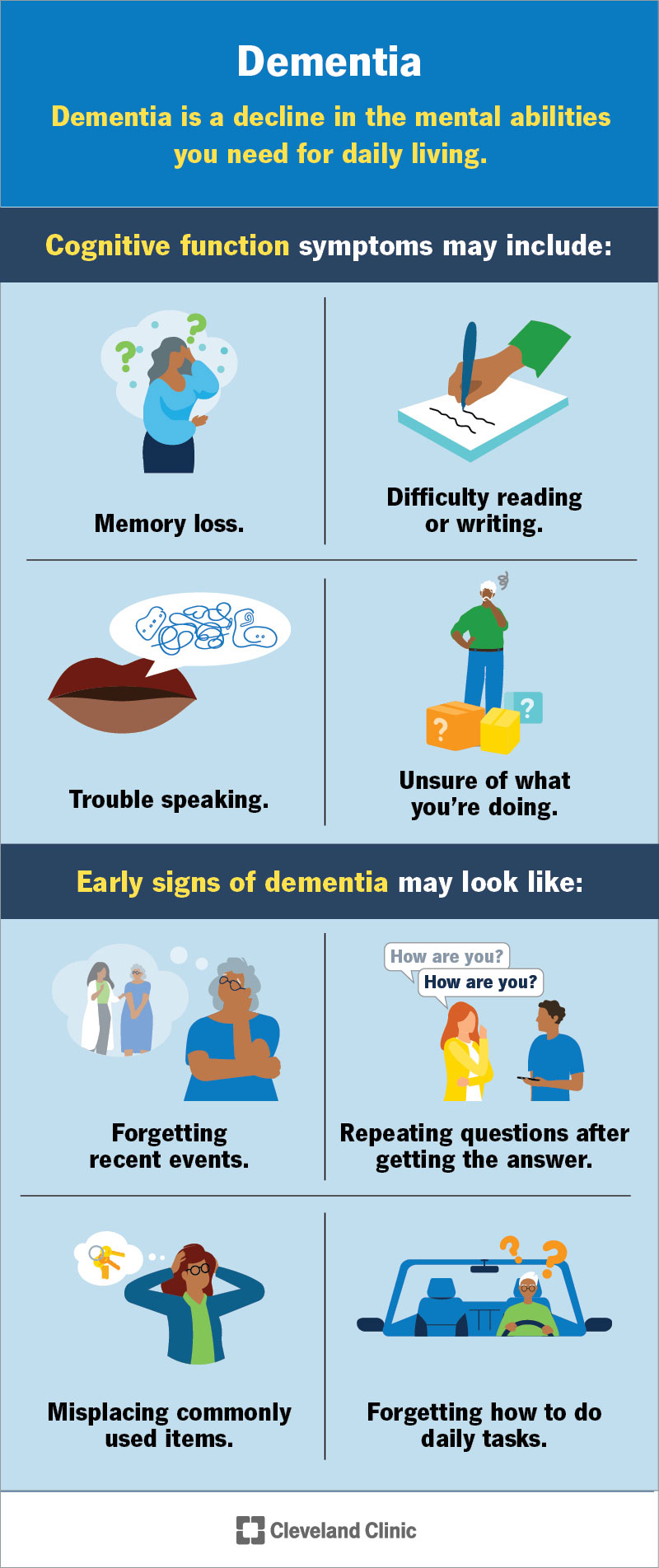
Image content: This image is available to view online.
View image online (https://my.clevelandclinic.org/-/scassets/images/org/health/articles/dementia)
Symptoms of dementia
Symptoms can vary based on the type and the area of your brain that has the most damage.
Cognitive symptoms
Cognitive symptoms are changes to your thinking and understanding. These may include:
Advertisement
- Difficulty sharing thoughts: Having trouble saying what you want to say
- Memory loss: Forgetting namespast events or things you just learned
- Problems following directions: Not understanding or remembering steps
- Trouble with language: Finding it hard to readwrite or understand words
Behavioral and psychological symptoms
These are changes in how you feel or relate to others. They can affect your moodinterests and personality. These may include:
- Agitation: Feeling restless or upset
- Anxiety: Feeling nervous or worried
- Depression: Losing interest or feeling sad
- Disorientation: Not knowing where you are or what time it is
- Irritability: Feeling frustrated or upset by tasks that used to be easy
- Hallucinations: Seeing or hearing things that aren’t really there
- Paranoia: Thinking others are trying to hurt or trick you
- Fidgeting or repeating movements: Pacing or finger tapping
- Sleep problems: Waking up often at night or sleeping during the day
Dementia stages
Doctors may describe dementia in stagesbased on how symptoms get worse over time. The three main stages are:
- Early-stage dementia (mild)
- Middle-stage dementia (moderate)
- Late-stage dementia (severe)
In the early stageit affects your daily lifebut not severely. You may notice some memory or thinking problemsbut you can still do most self-care tasks at homelike dressingbathing and making simple meals.
In the middle stagethinking and daily tasks become harder. You may need reminders or prompts to complete them.
In the late stageyou need daily help and may require full-time care. Most thinking skills are lostand you need support with basic activitieslike eatingbathing and getting dressed.
Dementia causes
Damaged brain cells cause dementia. In most casesthis damage comes from a neurodegenerative disease (a disease that slowly harms brain cells over time). These changes affect the parts of your brain that control memorylearninglanguage and decision-making.
Brain cells need to “talk” to each other by sending electrical signals. These signals help your brain work. When something blocks the signals or damages the cellsyour brain can’t work properly.
Researchers are still studying why dementia develops in some people and not in others. In rare casesa gene change can cause it.
Secondary dementia causes
Common disorders and conditions that cause secondary dementia include:
- Alcohol-related
- Creutzfeldt-Jakob disease
- Encephalitis
- Meningitis
- Multiple sclerosis
- Traumatic brain injury
- Wilson disease
Reversible dementia causes
With reversible dementiasymptoms may go away once your provider treats what’s causing them. Some common causes include:
- Bleeding in the brain (subdural hematomas)
- Brain tumors
- Diseases of other body organs (liver cirrhosisrenal failure)
- Fluid buildup in your brain (normal pressure hydrocephalus)
- Hormone-related disorders (Addison’s diseaseCushing’s diseasethyroid disorders)
- Infections (like HIVsyphilis)
- Medicine side effects (from certain drugslike anticholinergics or benzodiazepines)
- Vitamin deficiencies (not enough vitaminslike B1B6B12copper or vitamin E)
Advertisement
Risk factors
Certain factors may raise your chances of developing dementia. These include:
- Age: You can’t avoid itbut getting older is the biggest risk. Most diagnoses happen after age 65.
- Family history: If a biological parent or sibling has ityou may be more likely to get ittoo.
- Down syndrome: This condition increases your risk of getting symptomsespecially at an earlier age.
- Heart and blood vessel problems: Conditions like high blood pressurehigh cholesteroldiabetes and smoking can damage blood vessels. Poor blood flow and strokes can increase your risk as well.
- Race and ethnicity: Black adults are about twice as likelyand Hispanic adults are about 1.5 times more likely than white adults to develop dementia.
- Serious brain injury: A severe head injury and loss of consciousness during your life can raise your risk.
Complications
Your brain controls everything your body does. When it stops working properlyit can affect your overall health. Dementia can lead to serious problemsincluding:
- Bedsores
- Dehydration and poor nutrition
- Trouble managing your pee or poop
- Fallsinjuries or broken bones
- Pneumonia
- Sepsis
Some of these problems can be life-threatening if not treated quickly. Unmanaged symptoms may lead to early death.
Advertisement
Diagnosis and Tests
How doctors diagnose dementia
To find out if you have dementiaa provider will:
- Ask about your symptomslike when they started and how often they happen
- Review your personal and family medical history
- Look at the medications you’re currently taking
- Order tests
Diagnosing dementia can take time. That’s because many other disorders can cause similar symptoms. Your care team may need to rule out other problems first. While they work on getting the right diagnosisthey’ll help you manage symptoms.
Dementia testing
Your provider may use one or more of the following tests to confirm a diagnosis:
- Blood tests
- CT scan
- MRI
- Mental status exam
- PET scan
- Neuropsychiatric evaluation
- Spinal tap (lumbar puncture)
Management and Treatment
Is there a cure for dementia?
Right nowthere’s no cure. Researchers are working to better understand it. But many types of dementia are treatable.
How is dementia treated?
No treatment can completely stop dementia from getting worse. But your provider can help you manage symptoms and reduce how much they affect your daily life.
Treatment can look different for each person because dementia affects everyone in different ways. What works well for one person may not work the same for you. Some treatments may also become less helpful as the disease progresses.
Dementia medications
Medicines are usually the first type of treatment for most kinds of dementia. Common options include:
Advertisement
- Cholinesterase inhibitors (donepezil, rivastigminegalantamine): These improve memory by changing the chemical balance in your brain.
- NMDA receptor antagonist (memantine): This medicine controls signals in your brain. It may help with memory and make it easier to do everyday activities.
- Anti-amyloid therapies (lecanemabdonanemab): These medications may help in early stages of Alzheimer’s disease. They slow disease progression and are effective by removing the amyloid plaques in your brain.
- Antidepressants and antipsychotics: These may help with mood and behavior changesanxiety or other symptoms.
Your provider will explain which medicine is best for you and what side effects to watch for before starting treatment.
Non-medication-related dementia treatment
Treatment may include additional ways to support and improve your brain functionincluding:
- Managing any health conditions that affect your brainlike diabetes and blood pressure
- Balancing your vitamincalciumthyroid or blood sugar levels
- Changing your medication type or dose
- Having surgery to remove a tumor or reduce pressure in your brain
- Treating infections with medications
- Eating heart-healthy foods
- Participating in regular physical exercise
- Being socially engaged
- Having hobbies to challenge your thinking skills
When should I see a healthcare provider?
Make an appointment with a provider if you or your loved ones notice changes in your:
- Ability to perform everyday tasks
- Behavior
- Memory
- Mental functioning
What questions should I ask my healthcare provider?
If you or a loved one has dementiayou may want to ask a healthcare provider:
- What symptoms should I look out for?
- What type of treatment do you recommend?
- What is the life expectancy?
- Is living independently possible?
- Is driving safe?
Outlook / Prognosis
Video playlist content: This video playlist is available to watch online.
View video playlist online (https://cdnapisec.kaltura.com/p/2207941/sp/220794100/playManifest/entryId/1_i18c4vdo/flavorId/1_5f3sgelj/format/applehttp/protocol/https/a.mp4)
Learn more about living with Alzheimer’s disease.
What can I expect if I have dementia?
Dementia gets worse over time. Even with treatmentyour memory and thinking skills may continue to decline. This can affect your safety and ability to care for yourself or loved ones.
It’s a good idea to make an advance directive. This is a written plan that tells your providers and family what kind of medical care you want in the future.
As symptoms progressyou may have to make tough decisions to stay safe. This could include:
- Not driving
- Getting help at home
- Moving to a full-time care facility
These choices aren’t easy and can affect your emotions. Talking to a mental health professional or joining a support group may help you cope.
Researchers are still studying ways to cure dementia. New treatments and care options may be available in the future.
What’s the life expectancy of a person with dementia?
Dementia is a serious condition that usually shortens your life. But how long you live with dementia can vary.
One study found that people with Alzheimer’s disease lived for about 5.8 years after getting a dementia diagnosis. But people can live longer if they’re in otherwise good medical health.
Providers look at many things to help estimate life expectancyincluding:
- Your overall health
- Any other medical conditions you have
- How advanced symptoms are
Each person’s medical history and life situation is different. Both can affect life expectancy.
Prevention
Can dementia be prevented?
You can’t prevent all types. But there are ways to lower your risk for some kinds. A healthcare provider can help you stay healthy and keep your brain strong. They may suggest:
- Quit smoking.
- Eat healthy meals with a balance of fruitsvegetables and whole grains.
- Be active for at least 30 minutes most days of the week.
- Keep your brain busy with puzzlesword gamesreading or new activities.
- Stay social by talking with friends and family to support your mental and emotional health.
- Get your hearing and vision checked and treated to decrease risk of cognitive impairment.
- Manage your risk factorslike diabeteshigh blood pressure and cholesterol carefully.
A note from Cleveland Clinic
Hearing that you have dementia is never easy. It’s normal to feel overwhelmed and worry about what lies ahead. This might distract you from the present and enjoying time with the people you love.
While no one can predict the futureyou can take steps to plan for it. There are treatments that may help slow the symptoms of dementia. You may also want to talk with your healthcare provider or a social worker about completing important documentslike legalfinancial and medical plans. These help make sure your wishes are clearso others can speak up for you when you can’t.
Rememberyour care team will be there to support you every step of the way. Help is available for both you and your loved ones throughout this journey.



Better health starts here
Sign up for our Health Essentials emails for expert guidance on nutritionfitnesssleepskin care and more.
Experts You Can Trust
Learn more about the Health Library and our editorial process.
References
Cleveland Clinic’s health articles are based on evidence-backed information and review by medical professionals to ensure accuracyreliability and up-to-date clinical standards.
Experts You Can Trust
References
Cleveland Clinic’s health articles are based on evidence-backed information and review by medical professionals to ensure accuracyreliability and up-to-date clinical standards.
- Alzheimer’s Association (U.S.). What is Dementia? (https://www.alz.org/alzheimers-dementia/what-is-dementia) Last reviewed 10/22/2019. Accessed 12/5/2025.
- Centers for Disease Control and Prevention (U.S.). About Dementia (https://www.cdc.gov/alzheimers-dementia/about/index.html). Last reviewed 8/17/2024. Accessed 12/5/2025.
- Emmady PDSchoo CTadi P. Major Neurocognitive Disorder (Dementia) (https://www.ncbi.nlm.nih.gov/books/NBK557444/). 2022 Nov 19. In: StatPearls [Internet]. Treasure Island (FL): StatPearls Publishing; 2025 Jan-. Accessed 12/8/2025.
- National Health Service (U.K.). What is dementia? (https://www.nhs.uk/conditions/dementia/about-dementia/what-is-dementia/) Last reviewed 7/20/2023. Accessed 12/5/2025.
- National Institute on Aging (U.S.). What is Dementia? SymptomsTypesand Diagnosis (https://www.nia.nih.gov/health/alzheimers-and-dementia/what-dementia-symptoms-types-and-diagnosis). Last reviewed 12/8/2022. Accessed 12/5/2025.
- National Institute of Neurological Disorders & Stroke (U.S.). Dementias (https://www.ninds.nih.gov/health-information/disorders/dementias). Last reviewed 8/27/2024. Accessed 12/5/2025.
Care at Cleveland Clinic
It can be unsettling when your brain stops working like it used to. Cleveland Clinic’s cognitive decline experts help you manage the symptoms and provide support.
