




×

注意!页面内容来自https://science.nasa.gov/dark-matter/,本站不储存任何内容,为了更好的阅读体验进行在线解析,若有广告出现,请及时反馈。若您觉得侵犯了您的利益,请通知我们进行删除,然后访问 原网页

Dark Matter

What is Dark Matter?

Dark matter is the invisible glue that holds the universe together. This mysterious material is all around usmaking up most of the matter in the universe. But what exactly is dark matter? That's a question that scientists have been trying to solve for almost 100 years. 

Dark matter makes up most of the mass in galaxies and galaxy clusters. In factscientists estimate that ordinary matter makes up only about 5% of the universewhile dark matter makes up about 27%. (The rest is thought to be dark energywhich is its own mystery). It's thought that dark matter shapes the cosmosorganizing galaxies and cosmic objects on a large scale. 

Universe Pie Chart
The universe is made up of three components: normal or visible matter (5%)dark matter (27%)and dark energy (68%).
NASA's Goddard Space Flight Center

From stars and galaxies to the shoes on your feetordinary matter makes up everything we can see in the universe — in wavelengths spanning from the infrared to visible light and gamma rays. While dark matter interacts with ordinary matter through gravityit does not seem to interact at all with the electromagnetic spectrumincluding visible light. So dark matter doesn't absorbreflector emit any light. 

While dark matter is invisibleit does have some things in common with ordinary matter: It takes up space and it holds mass. Because of thiswe can see how it interacts with and influences ordinary matter throughout the universewhich is how we're able to "see" and study dark matter. 

Sowhat can we see? And what have we seen that makes us so sure that dark matter exists?
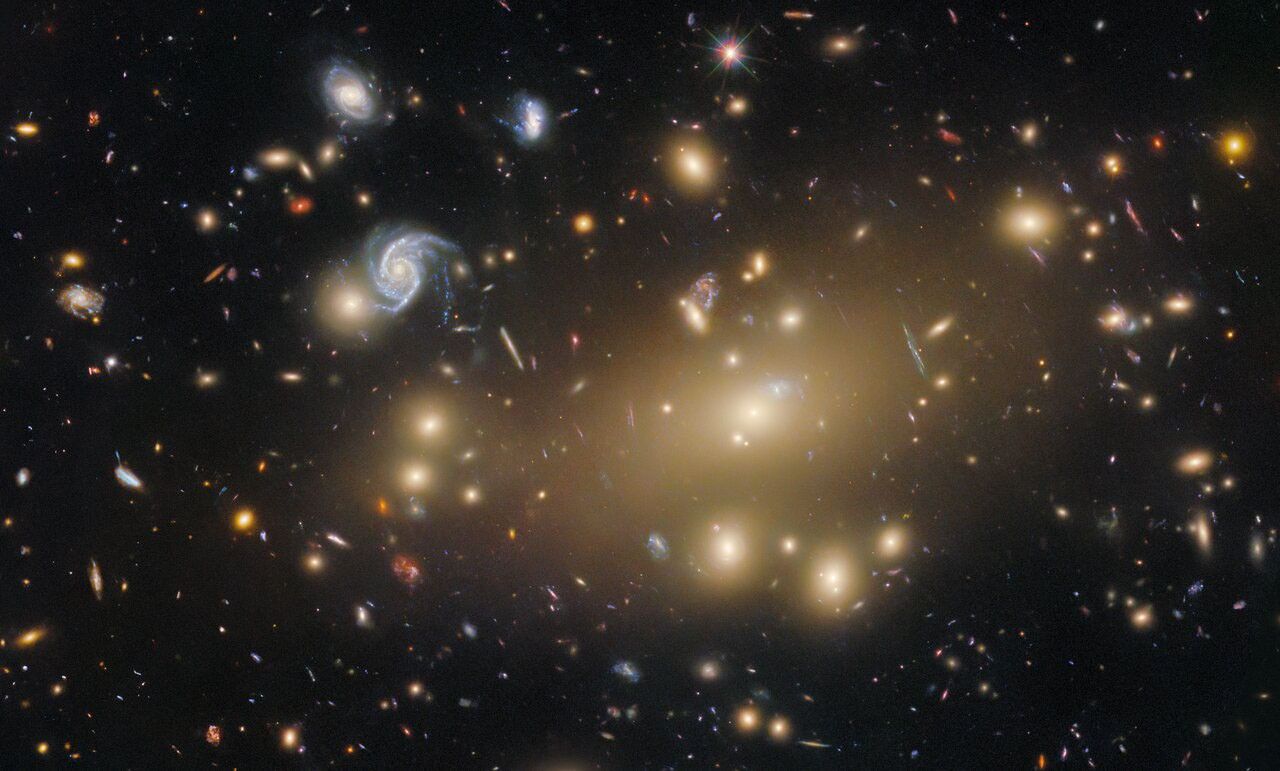
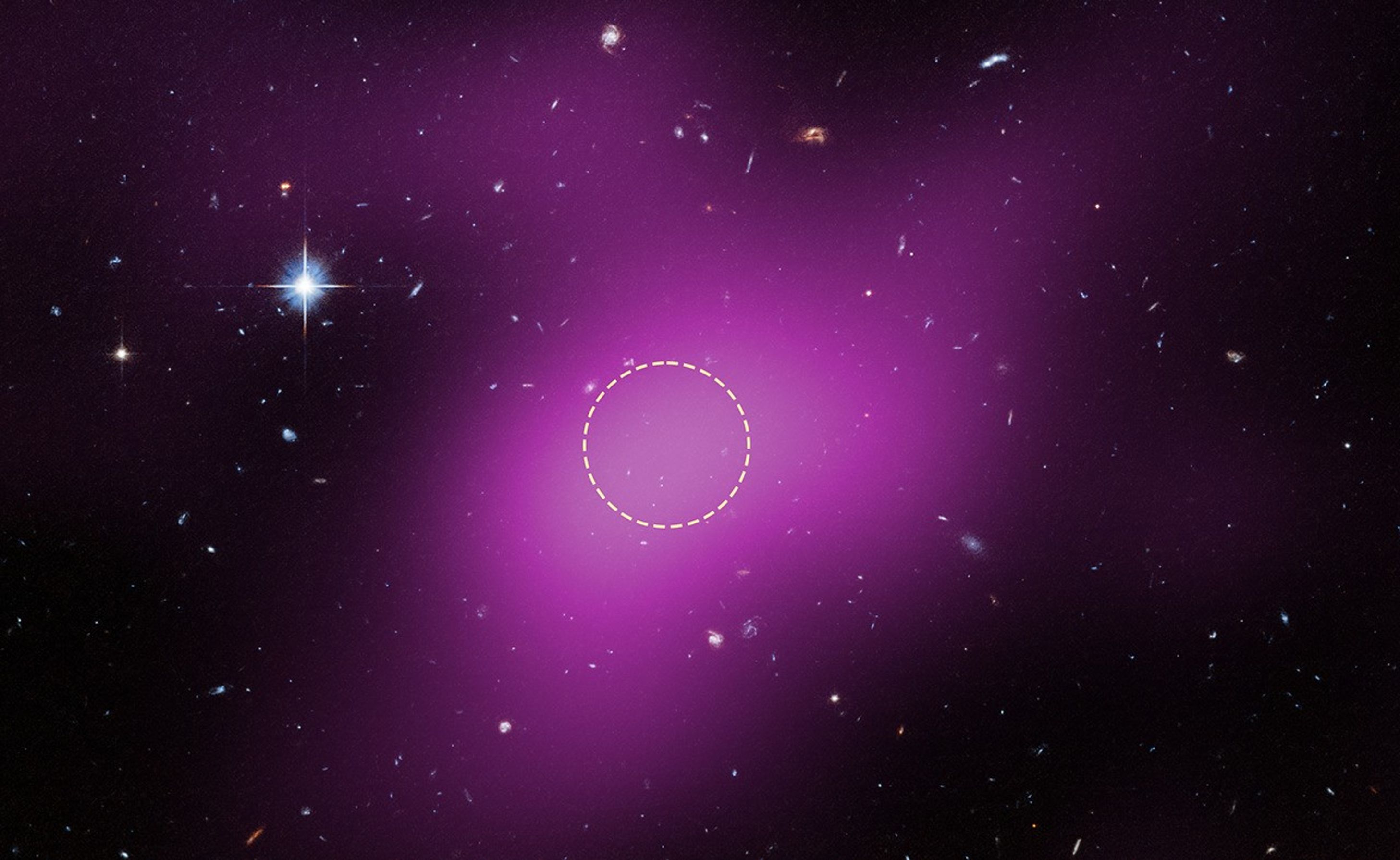
A cluster of distantmainly elliptical galaxies. They appear as brightly shining points radiating golden light that each take the shape of a smoothfeatureless oval. They crowd around one that is extremely large and bright. A few spiral galaxies of comparable size appear toobluer in color and with unique shapes. Of the other more small and distant galaxies covering the scenea few are warped into long lines.
The massivespacetime-warping cluster of galaxies shown here in this image from NASA's Hubble Space Telescope is Abell 209located 2.8 billion light-years away in the constellation Cetus. Abell 209’s galaxies are separated by millions of light-yearsand the seemingly empty space between the galaxies is filled with hotdiffuse gas that is visible only at X-ray wavelengths. An even more elusive occupant of this galaxy cluster is dark matter. The immense mass of a galaxy cluster can bend the fabric of spacetime itself and create warped and magnified images of background galaxies and stars in a process called gravitational lensing.  While this image lacks the dramatic rings that gravitational lensing can sometimes createAbell 209 still shows subtle signs of lensing at workin the form of streakyslightly curved galaxies within the cluster’s golden glow. By measuring the distortion of these galaxiesastronomers can map the distribution of mass within the clusterilluminating the underlying cloud of dark matter. 
ESA/Hubble & NASAM. PostmanP. Kelly

Discovering Dark Matter

It might seem impossible to discover something that can't be seenbut scientists have been trying to untangle the mystery of dark matter since at least the 1930s. It was during this time that astronomers observed what seemed to be "missing matter" in galaxies.  

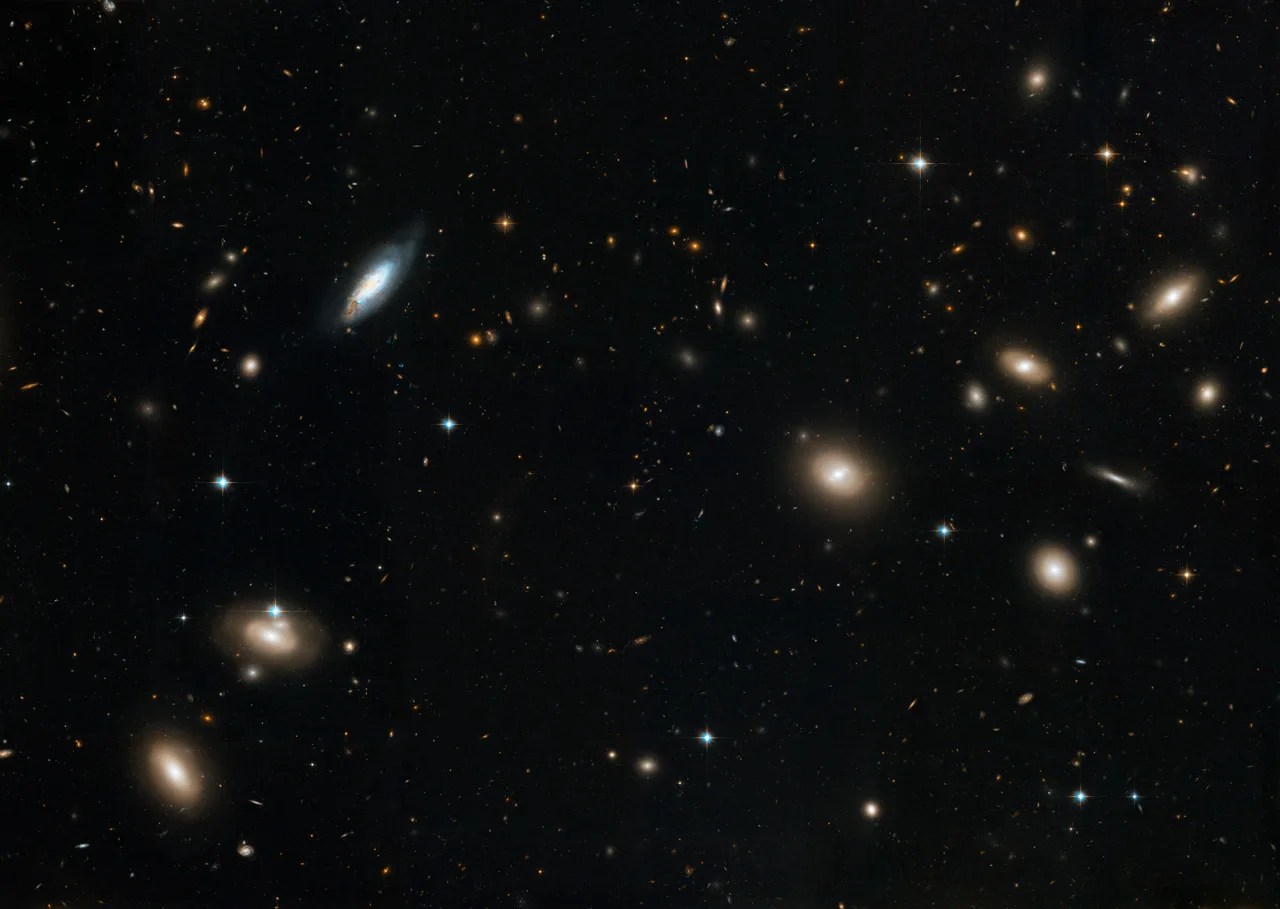
While the term dark matter was mentioned in earlier publicationsthe current concept of dark matter materialized in the early 1930s. In 1933Swiss-born astronomer Fritz Zwicky published a paper in which he described an anomaly he observed studying a cluster of galaxies known as the Coma Cluster. He noticed that the galaxies in the cluster moved too quickly for the gravity created by its observed ordinary matter. The galaxies should have been escaping the clusterbut insteadthey were staying together.

After noting this discrepancyZwicky suggested that there might be an invisible form of matter that created the gravity holding these galaxies together. He dubbed this mysterious material "dunkle Materie," which is German for dark matter. 

While these early investigations sparked ideas and curiosity around dark matterit was still seen as a fringe concept without sufficient evidence to support it. 

That changed in the 1970s when American astronomer Vera Rubin observed this "missing matter" problem in spiral galaxies. Rubin looked at the stars on the outer edges of the spirals. To explain why these stars moved as fast as they did without flying into intergalactic spacethere had to be a large amount of matter holding them in place. Butnot seeing any of this matterRubin concluded that these galaxies must be held together by dark matter. 

Rubin's discovery provided such strong evidence for dark matter that the concept was embraced by the scientific community. Todaywhile not all astronomers agree on what dark matter might beits existence is widely accepted. 

Studying Dark Matter

Todayscientists have even more direct evidence of dark matter. While dark matter doesn't interact with lightits gravity can bend light from distant galaxiescreating an effect called gravitational lensing. Studying galaxies distorted by gravitational lensing can help scientists better understand dark matter and its place in the universe. 
Thousands of overlapping objects at various distances are spread across this fieldincluding galaxies in a massive galaxy clusterand distorted background galaxies behind the galaxy cluster. The background of space is black.
Thousands of glimmering galaxies are bound together by their own gravitymaking up a massive cluster formally classified as MACS J1423. The largest bright white oval is a supergiant elliptical galaxy and the dominant member of this galaxy cluster. The galaxy cluster acts like a...
Image: NASAESACSASTScIChristopher Willott (NRC-Canada)Lamiya Mowla (Wellesley College)Kartheik Iyer (Columbia)

In 2006scientists observed the Bullet Cluster and discovered some of the best direct evidence for dark matter. This galaxy clusterformally known as 1E 0657-56was created when two large galaxy clusters collided in an extremely energetic event about 3.8 billion light-years from Earth.

During this collisionhot gas from one cluster interacted with hot gas from the other. In the image belowhot X-ray emitting gas made of normal matter and detected by NASA's Chandra X-ray Observatory is shown in pink. The blue portions show the distribution of dark matter and were revealed using gravitational lensing observations taken by NASA’s Hubble Space Telescope and the Giant Magellan Telescopewhich is operated by an international consortium. The blue areas represent most of the mass in these clusters and are distributed differently than the hot gas. Researchers think that this material is likely dark matter. Soin this imageyou can see direct evidence of dark matter with your own eyes. 
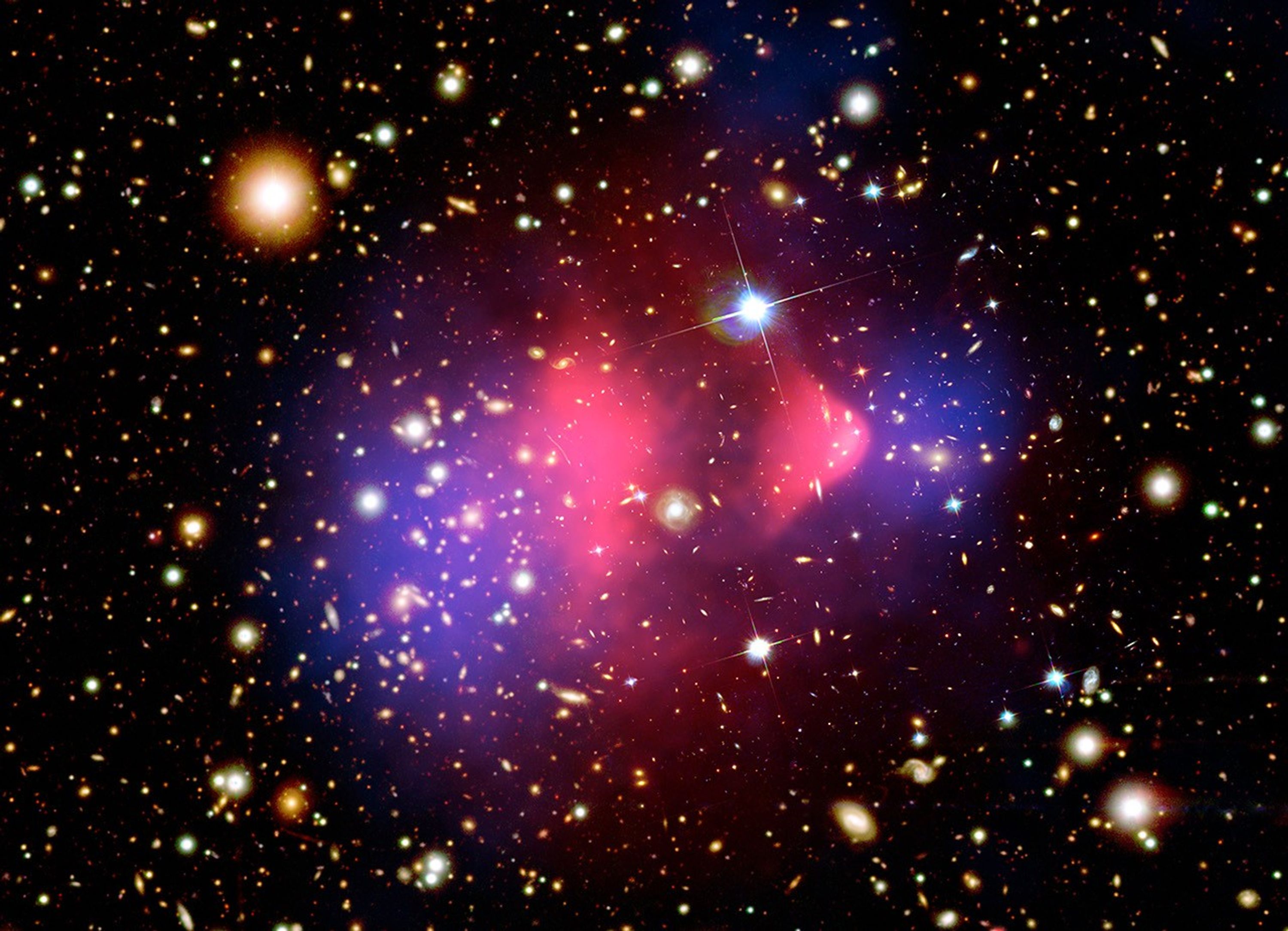
This image shows two colorful gas cloudsboth with hot pink gas at the center and blue-purple gas around the edgesindicating the presence of dark matter after a galactic collision.
This composite image captured using NASA's Hubble Space Telescope and Chandra X-ray Observatory and the ground-based Giant Magellan Telescope shows the Bullet Clustera pair of galaxy clusters that collided. Normal matter is shown in the cluster in pinkwhile gravitational lensing reveals dark matter in the cluster shown in blue. This observation has provided one of the clearest direct examples of dark matter.
X-ray: NASA/CXC/CfA/M.MarkevitchOptical and lensing map: NASA/STScIMagellan/U.Arizona/D.CloweLensing map: ESO WFI

With sufficient evidence to support dark matter's existencescientists are working hard to explore not only what dark matter is but also where it's distributed throughout the universe. 

Since dark matter is essentially the glue holding the universe togethera better understanding of the distribution of dark matter will help answer big cosmic questions about how the universe is organized and how it has changed over the course of cosmic history. Maps showing the distribution of dark matter — created with the help of missions like NASA’s upcoming Nancy Grace Roman Space Telescope — will help scientists answer these questions and continue to piece together the strangetrue history of our universe. 

Taking Dark Matter's Temperature

Because dark matter has massit also must have a temperature.  

For a whilescientists considered two options — cold dark matter made up of slow-moving particles and warm or hot dark matter made of faster-moving particles. 

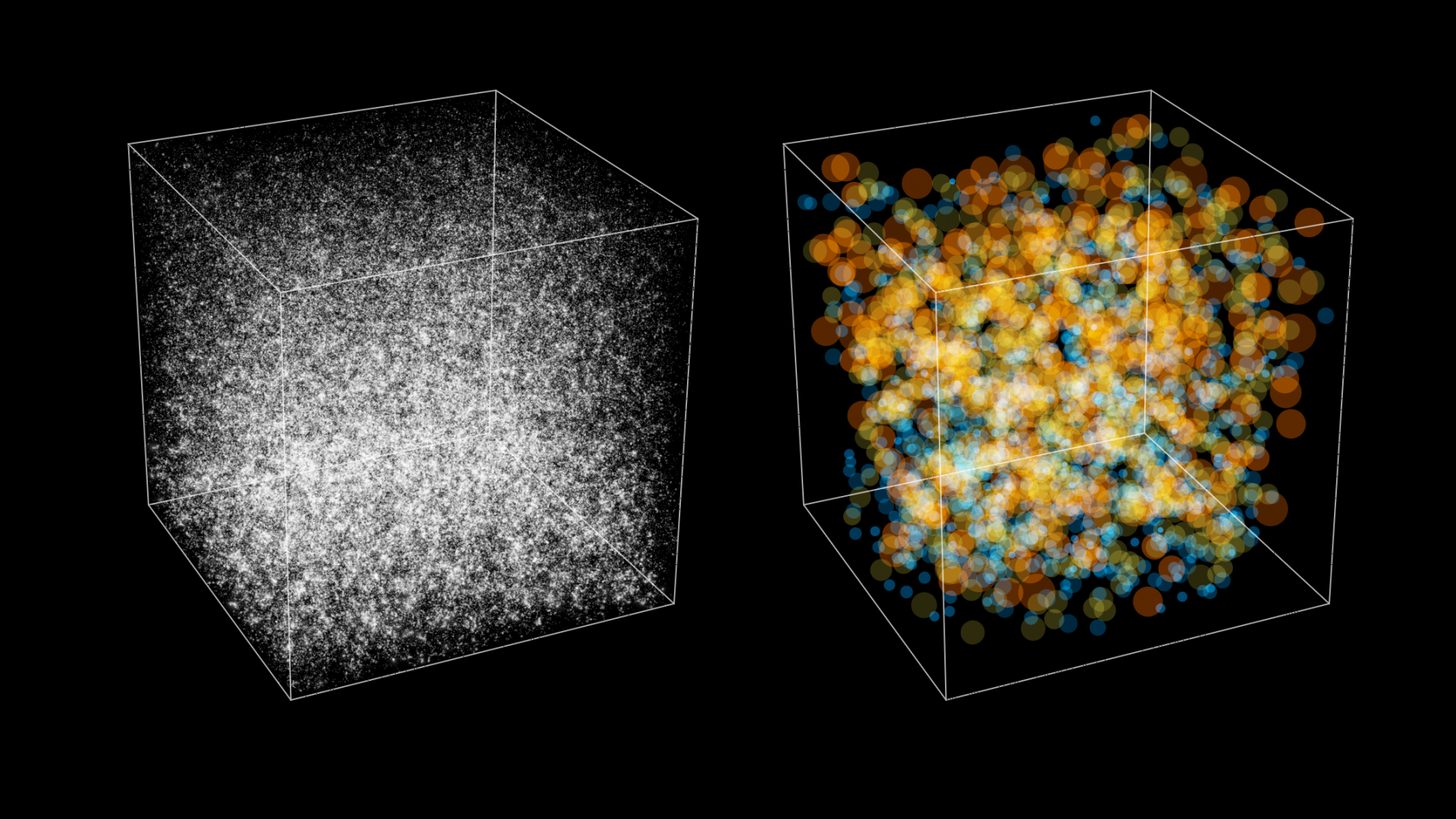
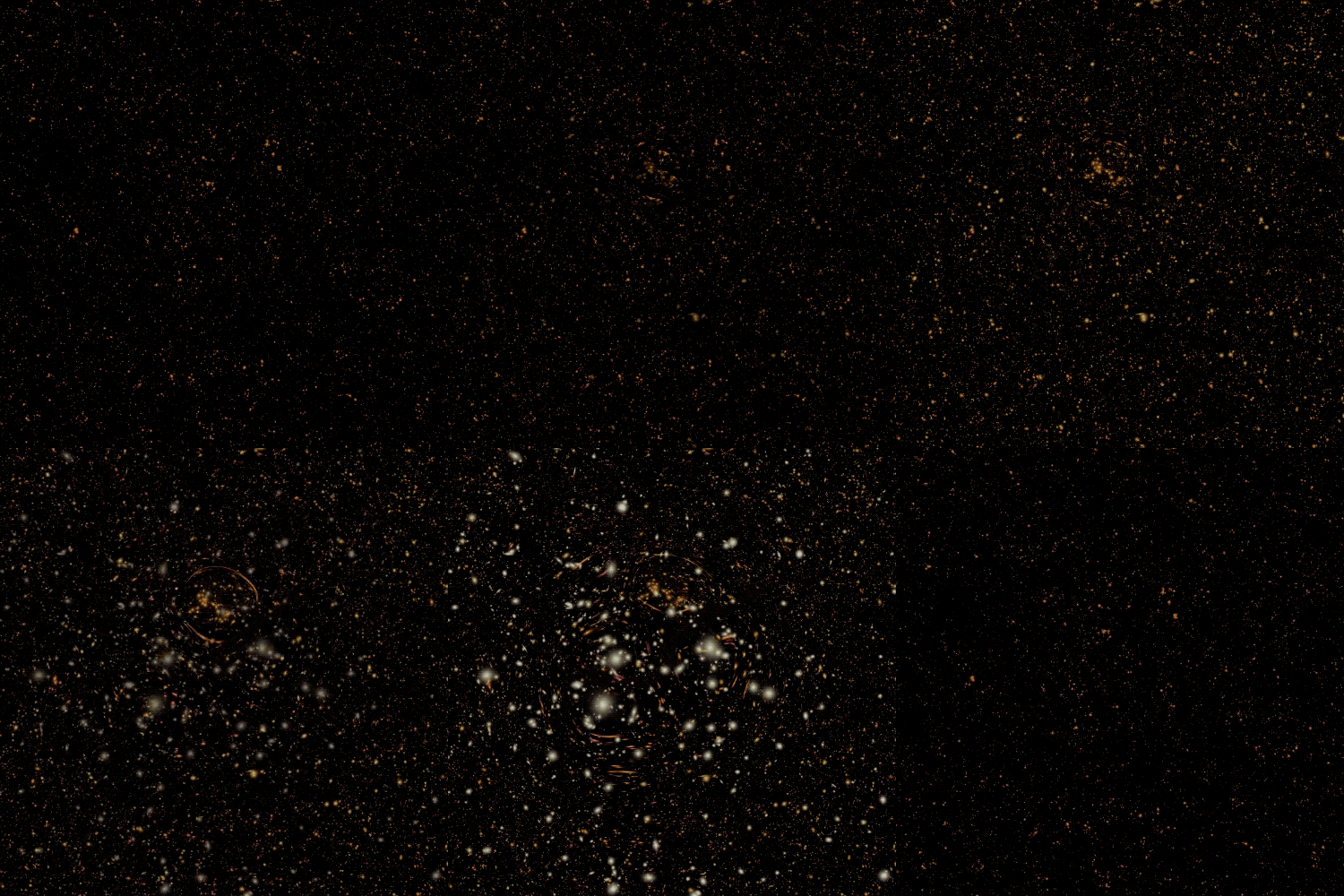
In simulationsscientists modeled how our universe would operate if dark matter was cold and slow versus if it was hot or warm and fast. They showed that with cold dark matterthe universe’s structures appear to exist and move as they are observed in reality. When the simulations were done with warm or hot dark matterhowevercosmic structures don't seem able to stick together and can't exist in the ways we observe. 

Based on such simulationsscientists currently agree that it is most likely that whatever dark matter isit is cold or slow-moving. It's additionally thought that this cold dark matter formed in the early universe with a low enough velocity to allow galaxies to form and distribute as we see them today. 

Leading Dark Matter Candidates

There are currently many proposed explanations for what makes up dark matter. In factscientists think it's possible that dark matter made up of more than one kind of matter or particle.

 Below are a few of the current candidates with the most support from the scientific community. For contextscientists have been searching for these candidates but have not yet found evidence which would confirm any candidate. New candidates may also continue to emerge.  

  • WIMPs (Weakly Interacting Massive Particles)
    WIMPs are hypothetical particles that are bigheavyand slow-moving. They don't absorb or emit light or strongly interact with any other particles that we've seen so far. Scientists think WIMPs interact with gravity and possibly other forcesbut in a way that allows these particles to pass through normal matter almost seamlessly. When WIMPs interact with each otherhoweverthey may cancel each other out. That destruction could produce gamma rays. Scientists have even searched through data from NASA's Fermi Gamma-ray Space Telescope to look for signatures of WIMPs interacting and annihilating one another.  
This animation shows a Weakly Interacting Massive Particleor WIMPnot moving or reacting when an electron or proton pass near to it. Then another WIMP comes into view and they smash togetherdisappearing as a pair of gamma-rays are emitted.
WIMPsor Weakly Interacting Massive Particlesrepresent a favored class of dark matter candidates. Some WIMPs may mutually annihilate when pairs of them interacta process expected to produce gamma rays — the most energetic form of light.
NASA's Goddard Space Flight Center
  • Axions
    Axions are hypothetical subatomic particles scientists think are both low-mass and low-energy. This particle was first theorized in 1977 as a solution to a fundamental problem within particle physics called the strong CP problem. (CP stands for charge conjugation symmetry and parity symmetry.) In essencethe problem is that when regular matter particles are inverted or swapped with antimatter particlesthe laws of physics should remain the sameand the particles should be symmetrical and cancel out. This would mean that in the first moments of the universematter and antimatter should have canceled each other out. But that didn't happen. Scientists proposed axions as a hypothetical particle that could solve the strong CP problem by violating this symmetry to allow regular matter to flourish. Scientists think that these hypothetical particles could be dark matter and have found additional evidence for the existence of axions over the years. Scientists have also used data from NASA telescopes including FermiChandraand NuSTAR (Nuclear Spectroscopic Telescope Array) to search for evidence of axion oscillations in X-ray and gamma-ray observations.  
  • Primordial black holes
    Black holes are the densest objects in the universe with gravity so extreme that at a certain point not even light can escape. Primordial black holes are hypothetical black holes scientists think formed right after the birth of the universe. Primordial black holes could be as small as an atom or as large as a supermassive black holewith possible masses ranging from 100,000 times less massive than a paperclip to 100,000 times more massive than the Sun. Recent studies suggest a primordial black hole could travel through our solar system once every 10 yearswhich may allow scientists to eventually study them directly. One theoryproposed by physicist Stephen Hawkingsuggests that after primordial black holes formed from regular matter at the start of the universethey collapsedbecoming dark matter that spread out across the universe. Scientists use data from Fermi to search for primordial black hole evaporation.

Dark Matter Versus Dark Energy

Dark matter often causes confusion because of its name. Dark matter is not a dark color. Ratherit's called “dark” because it's invisible to us since it doesn't absorbreflector emit any light. 

Another misconception about dark matter relates to dark energy. While the two are both cosmic mysteries with "dark" in their namethey are not the same thing. Dark matter is a mysterious type of matter that holds galaxies together. Dark energy is the name scientists have given to whatever is causing our universe to expand at an accelerating rate over time — another cosmic mystery. Dark energy isn't concentrated in galaxies or galaxy clustersinstead scientists think it’s spread throughout the universe. 

Both dark matter and dark energy pose deepunanswered questions about the universe. Although they are distinct phenomenascientists map the distribution of dark matter to help us understand the universe's accelerated expansion which is caused by dark energy. 

By Chelsea Gohd
NASA's Jet Propulsion Laboratory
Keep Exploring

Discover More Topics From NASA

< id="nasa-blocks-hdsnav--inline-css"> < id="nasa-blocks-secondary-navigation--inline-css"> < id="nasa-blocks-page-intro--inline-css"> .popover-wrapper{display:none!important}.quick-facts-slider .quick-facts-slider-image{border-radius:50%;display:block;height:6rem;overflow:hidden;width:6rem}.quick-facts-slider-image .hds-media-background{position:relative}@media screen and (max-width:1279px)and (min-width:1175px){.quick-facts-slider .quick-facts-slider-image{height:5rem;width:5rem}}@media screen and (max-width:1174px){.quick-facts-slider .quick-facts-slider-image{height:4.5rem;width:4.5rem}}@media screen and (max-width:480px){.quick-facts-slider .quick-facts-slider-image{height:3.5rem;width:3.5rem}}@media screen and (max-width:400px){.quick-facts-slider .quick-facts-slider-image{height:3rem;width:3rem}}.hds-carousel-wrapper-relative .hds-carousel-nav{bottom:unset;justify-content:start;left:unset;position:relative}.wp-block-nasa-blocks-page-intro .slick-dots{display:none!important}.hds-carousel-nav-arrow{align-items:center;background:#fff;border:1px solid #b9b9bb;border-radius:50%;box-sizing:border-box;display:flex;height:40px;justify-content:center;margin-right:8px;transition:all .2s ease;width:40px}.hds-carousel-nav-arrow:hover{border:1px solid #000;cursor:pointer}.hds-page-intro-image-1,.hds-page-intro-image-2,.hds-page-intro-image-3{min-height:320px}@media screen and (max-width:800px){.hds-page-intro-image-1{min-height:200px}.hds-page-intro-image-2,.hds-page-intro-image-3{min-height:120px}}.quick-facts-slider .quick-facts-slider-image figure img{-o-object-fit:cover;object-fit:cover}.quick-facts-slider .quick-facts-slider-image figure{border-radius:50%;display:block;height:100%;margin:0;overflow:hidden;width:100%} < id="nasa-blocks-topic-cards--inline-css"> < id="wp-block-heading-inline-css"> h1.has-background,h2.has-background,h3.has-background,h4.has-background,h5.has-background,h6.has-background{padding:1.25em 2.375em}h1.has-text-align-left[*=writing-mode]:where([*=vertical-lr]),h1.has-text-align-right[*=writing-mode]:where([*=vertical-rl]),h2.has-text-align-left[*=writing-mode]:where([*=vertical-lr]),h2.has-text-align-right[*=writing-mode]:where([*=vertical-rl]),h3.has-text-align-left[*=writing-mode]:where([*=vertical-lr]),h3.has-text-align-right[*=writing-mode]:where([*=vertical-rl]),h4.has-text-align-left[*=writing-mode]:where([*=vertical-lr]),h4.has-text-align-right[*=writing-mode]:where([*=vertical-rl]),h5.has-text-align-left[*=writing-mode]:where([*=vertical-lr]),h5.has-text-align-right[*=writing-mode]:where([*=vertical-rl]),h6.has-text-align-left[*=writing-mode]:where([*=vertical-lr]),h6.has-text-align-right[*=writing-mode]:where([*=vertical-rl]){rotate:180deg} < id="wp-block-paragraph-inline-css"> .is-small-text{font-size:.875em}.is-regular-text{font-size:1em}.is-large-text{font-size:2.25em}.is-larger-text{font-size:3em}.has-drop-cap:not(:focus):first-letter{float:left;font-size:8.4em;font-:normal;font-weight:100;line-height:.68;margin:.05em .1em 0 0;text-transform:uppercase}body.rtl .has-drop-cap:not(:focus):first-letter{float:none;margin-left:.1em}p.has-drop-cap.has-background{overflow:hidden}:root :where(p.has-background){padding:1.25em 2.375em}:where(p.has-text-color:not(.has-link-color)) a{color:inherit}p.has-text-align-left[*="writing-mode:vertical-lr"],p.has-text-align-right[*="writing-mode:vertical-rl"]{rotate:180deg} < id="wp-block-image-inline-css"> .wp-block-image>a,.wp-block-image>figure>a{display:inline-block}.wp-block-image img{box-sizing:border-box;height:auto;max-width:100%;vertical-align:bottom}@media not (prefers-reduced-motion){.wp-block-image img.hide{visibility:hidden}.wp-block-image img.show{animation:show-content-image .4s}}.wp-block-image[*=border-radius] img,.wp-block-image[*=border-radius]>a{border-radius:inherit}.wp-block-image.has-custom-border img{box-sizing:border-box}.wp-block-image.aligncenter{text-align:center}.wp-block-image.alignfull>a,.wp-block-image.alignwide>a{width:100%}.wp-block-image.alignfull img,.wp-block-image.alignwide img{height:auto;width:100%}.wp-block-image .aligncenter,.wp-block-image .alignleft,.wp-block-image .alignright,.wp-block-image.aligncenter,.wp-block-image.alignleft,.wp-block-image.alignright{display:table}.wp-block-image .aligncenter>figcaption,.wp-block-image .alignleft>figcaption,.wp-block-image .alignright>figcaption,.wp-block-image.aligncenter>figcaption,.wp-block-image.alignleft>figcaption,.wp-block-image.alignright>figcaption{caption-side:bottom;display:table-caption}.wp-block-image .alignleft{float:left;margin:.5em 1em .5em 0}.wp-block-image .alignright{float:right;margin:.5em 0 .5em 1em}.wp-block-image .aligncenter{margin-left:auto;margin-right:auto}.wp-block-image :where(figcaption){margin-bottom:1em;margin-top:.5em}.wp-block-image.is--circle-mask img{border-radius:9999px}@supports ((-webkit-mask-image:none) or (mask-image:none)) or (-webkit-mask-image:none){.wp-block-image.is--circle-mask img{border-radius:0;-webkit-mask-image:url('data:image/svg+xml;utf8,');mask-image:url('data:image/svg+xml;utf8,');mask-mode:alpha;-webkit-mask-position:center;mask-position:center;-webkit-mask-repeat:no-repeat;mask-repeat:no-repeat;-webkit-mask-size:contain;mask-size:contain}}:root :where(.wp-block-image.is--rounded img,.wp-block-image .is--rounded img){border-radius:9999px}.wp-block-image figure{margin:0}.wp-lightbox-container{display:flex;flex-direction:column;position:relative}.wp-lightbox-container img{cursor:zoom-in}.wp-lightbox-container img:hover+button{opacity:1}.wp-lightbox-container button{align-items:center;-webkit-backdrop-filter:blur(16px) saturate(180%);backdrop-filter:blur(16px) saturate(180%);background-color:#5a5a5a40;border:none;border-radius:4px;cursor:zoom-in;display:flex;height:20px;justify-content:center;opacity:0;padding:0;position:absolute;right:16px;text-align:center;top:16px;width:20px;z-index:100}@media not (prefers-reduced-motion){.wp-lightbox-container button{transition:opacity .2s ease}}.wp-lightbox-container button:focus-visible{outline:3px auto #5a5a5a40;outline:3px auto -webkit-focus-ring-color;outline-offset:3px}.wp-lightbox-container button:hover{cursor:pointer;opacity:1}.wp-lightbox-container button:focus{opacity:1}.wp-lightbox-container button:focus,.wp-lightbox-container button:hover,.wp-lightbox-container button:not(:hover):not(:active):not(.has-background){background-color:#5a5a5a40;border:none}.wp-lightbox-overlay{box-sizing:border-box;cursor:zoom-out;height:100vh;left:0;overflow:hidden;position:fixed;top:0;visibility:hidden;width:100%;z-index:100000}.wp-lightbox-overlay .close-button{align-items:center;cursor:pointer;display:flex;justify-content:center;min-height:40px;min-width:40px;padding:0;position:absolute;right:calc(env(safe-area-inset-right) + 16px);top:calc(env(safe-area-inset-top) + 16px);z-index:5000000}.wp-lightbox-overlay .close-button:focus,.wp-lightbox-overlay .close-button:hover,.wp-lightbox-overlay .close-button:not(:hover):not(:active):not(.has-background){background:none;border:none}.wp-lightbox-overlay .lightbox-image-container{height:var(--wp--lightbox-container-height);left:50%;overflow:hidden;position:absolute;top:50%;transform:translate(-50%,-50%);transform-origin:top left;width:var(--wp--lightbox-container-width);z-index:9999999999}.wp-lightbox-overlay .wp-block-image{align-items:center;box-sizing:border-box;display:flex;height:100%;justify-content:center;margin:0;position:relative;transform-origin:0 0;width:100%;z-index:3000000}.wp-lightbox-overlay .wp-block-image img{height:var(--wp--lightbox-image-height);min-height:var(--wp--lightbox-image-height);min-width:var(--wp--lightbox-image-width);width:var(--wp--lightbox-image-width)}.wp-lightbox-overlay .wp-block-image figcaption{display:none}.wp-lightbox-overlay button{background:none;border:none}.wp-lightbox-overlay .scrim{background-color:#fff;height:100%;opacity:.9;position:absolute;width:100%;z-index:2000000}.wp-lightbox-overlay.active{visibility:visible}@media not (prefers-reduced-motion){.wp-lightbox-overlay.active{animation:turn-on-visibility .25s both}.wp-lightbox-overlay.active img{animation:turn-on-visibility .35s both}.wp-lightbox-overlay.show-closing-animation:not(.active){animation:turn-off-visibility .35s both}.wp-lightbox-overlay.show-closing-animation:not(.active) img{animation:turn-off-visibility .25s both}.wp-lightbox-overlay.zoom.active{animation:none;opacity:1;visibility:visible}.wp-lightbox-overlay.zoom.active .lightbox-image-container{animation:lightbox-zoom-in .4s}.wp-lightbox-overlay.zoom.active .lightbox-image-container img{animation:none}.wp-lightbox-overlay.zoom.active .scrim{animation:turn-on-visibility .4s forwards}.wp-lightbox-overlay.zoom.show-closing-animation:not(.active){animation:none}.wp-lightbox-overlay.zoom.show-closing-animation:not(.active) .lightbox-image-container{animation:lightbox-zoom-out .4s}.wp-lightbox-overlay.zoom.show-closing-animation:not(.active) .lightbox-image-container img{animation:none}.wp-lightbox-overlay.zoom.show-closing-animation:not(.active) .scrim{animation:turn-off-visibility .4s forwards}}@keyframes show-content-image{0%{visibility:hidden}99%{visibility:hidden}to{visibility:visible}}@keyframes turn-on-visibility{0%{opacity:0}to{opacity:1}}@keyframes turn-off-visibility{0%{opacity:1;visibility:visible}99%{opacity:0;visibility:visible}to{opacity:0;visibility:hidden}}@keyframes lightbox-zoom-in{0%{transform:translate(calc((-100vw + var(--wp--lightbox-scrollbar-width))/2 + var(--wp--lightbox-initial-left-position)),calc(-50vh + var(--wp--lightbox-initial-top-position))) scale(var(--wp--lightbox-scale))}to{transform:translate(-50%,-50%) scale(1)}}@keyframes lightbox-zoom-out{0%{transform:translate(-50%,-50%) scale(1);visibility:visible}99%{visibility:visible}to{transform:translate(calc((-100vw + var(--wp--lightbox-scrollbar-width))/2 + var(--wp--lightbox-initial-left-position)),calc(-50vh + var(--wp--lightbox-initial-top-position))) scale(var(--wp--lightbox-scale));visibility:hidden}} < id="wp-block-list-inline-css"> ol,ul{box-sizing:border-box}:root :where(.wp-block-list.has-background){padding:1.25em 2.375em} < id="nasa-blocks-news-automated--inline-css"> .hds-news a{text-decoration:none}.hds-news-item-bubble{align-items:center}.wp-block-nasa-blocks-latest-news .news-item .hds-cover-wrapper{min-height:25rem}.news-item-stack .news-item .hds-cover-wrapper{height:100%;min-height:0}.news-item>.hds-cover-wrapper{min-height:410px}@media screen and (max-width:800px){.news-item-stack .news-item .hds-cover-wrapper{min-height:200px}.wp-block-nasa-blocks-latest-news .news-item-stack{flex-direction:row}.news-item>.hds-cover-wrapper{min-height:320px}}.wp-block-nasa-blocks-latest-news a,.wp-block-nasa-blocks-latest-news a:focus,.wp-block-nasa-blocks-latest-news a:hover{text-decoration:none}.wp-block-nasa-blocks-latest-news .news-item .nasa-block-cover{min-height:25rem}.news-item-stack{display:flex;flex-direction:column}.news-item-stack .news-item .nasa-block-cover{height:100%;min-height:0}@media screen and (max-width:800px){.news-item-stack .news-item .nasa-block-cover{min-height:200px}.wp-block-nasa-blocks-latest-news .news-item-stack{flex-direction:row}}.wp-block-nasa-blocks-latest-news .news-item .wp-block-cover{min-height:25rem}.wp-block-nasa-blocks-latest-news .news-item-stack{display:flex;flex-direction:column}.wp-block-nasa-blocks-latest-news .news-item-stack .news-item .wp-block-cover{height:100%;min-height:0}.wp-block-nasa-blocks-latest-news .latest-news-thumbnail-circle{border-radius:50%;height:4.5em;min-height:1px;width:4.5em}@media screen and (max-width:800px){.wp-block-nasa-blocks-latest-news .news-item-stack .news-item .wp-block-cover{min-height:200px}.wp-block-nasa-blocks-latest-news .news-item-stack{flex-direction:row}}.wp-block-nasa-blocks-featured-news a,.wp-block-nasa-blocks-featured-news a:focus,.wp-block-nasa-blocksfeatured-news a:hover{text-decoration:none}.latest-news-items .hds-cover-wrapper{height:100%!important}.latest-news-item a{display:block}